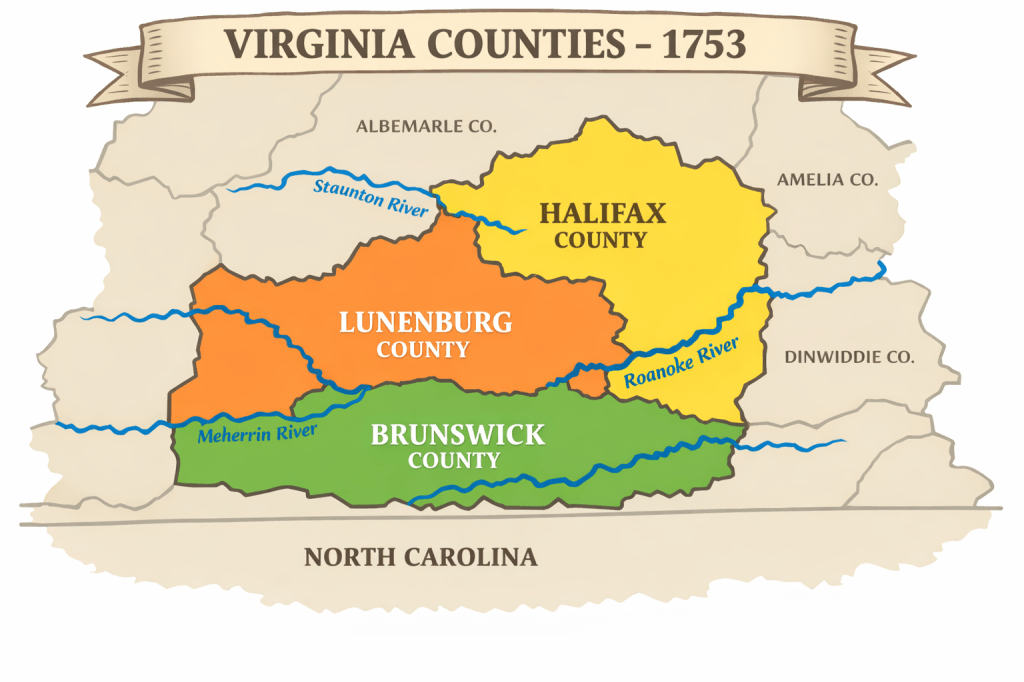
The first question to come for MortonLegacy.org involves the confusion regarding Joseph Morton of Halifax County versus Joseph Morton of Brunswick County. The easiest way to answer this confusion is to recognize the division and dates of county origin and creation.
The shifting county boundaries of colonial Virginia explain why Joseph Morton of Brunswick appears in both Brunswick and Halifax records during a transition of county borders. Brunswick County was the parent county for the region until 1746, when its western portion was cut off to form Lunenburg County. Less than two years later, the decision was made for the northern half of Lunenburg to again be divided to create Halifax County. The exact date of this new transition is not known, but by the end of 1752 a new boundary was announced, taking effect between late 1752 and early 1753. Halifax County would border both Lunenburg County, and extend down toward the border of Brunswick County. Families living along this rural and confusing line—such as John Binum, whose land straddled the changing jurisdiction—suddenly found themselves under a different county’s authority. As a result, Joseph Morton of Brunswick (my line) filed his 1753 debt‑recovery action in both Brunswick and Halifax, not because he moved, but because the county line moved over the location of the dispute and John Binum was in that area. At the same time, the other Joseph Morton in the region—the one belonging to the unrelated Halifax/Orange‑VA Morton family—had already written his will in 1749 and was dead before March 1753, when his estate was probated in Halifax. In contrast, Joseph Morton Sr., son of John the Immigrant, lived several years longer, with his estate not divided until 1758 in Brunswick County, confirming that the two men were entirely separate individuals caught in different jurisdictions and different family lines.
The counties of Brunswick, Lunenburg, and Halifax were created in rapid succession, and their shifting borders directly affected where records were filed. This is why Joseph Morton Sr. of Brunswick (my line) appears in both Brunswick and Halifax records in 1753 when he pursued a debt recovery involving Binum. For DECADES Morton researchers “combined” both Joseph Morton men without recognizing a difference. This error was repeated.
Genetic historians were finally able to apply science to separate all the Morton lines in Virginia and group them into three distinct Morton groups: the Henrico Morton group of John the Immigrant, the separate Richmond to Orange County “Northern neck” group, and the separate “Coastal” Northumberland Northern neck group. Modern DNA tools made it possible to see what the paper trail alone could never fully reveal. We can be grateful to those who initiated this undertaking!
All groups of Mortons share deep paternal roots in Yorkshire, England, long before anyone named Morton ever set foot in Virginia. That ancient connection is why descendants of all lines sometimes match at low levels on autosomal tests. But the breakthrough came when researchers began isolating maternal‑line DNA clusters—the female surnames that travel through families generation after generation. Once those clusters were mapped, the completely different communities emerged. Concerning the Halifax/Lunenburg → Pittsylvania → Orange County, VA Morton group: they carried the maternal signatures of the elite planter families of northern and central Virginia—Earle, Roy, Bourn, Snead, Mothershead, and Street. In contrast, the Brunswick → Lunenburg → Granville/Orange NC Morton line carried the Saponi/Occoneechi‑adjacent and frontier maternal clusters—Harris, Self, Martin, Wren, Russell, Jeffries, Nance—along with their long‑standing frontier neighbors Thompson, Allen, Brooks, Reynolds, Murphree, and Bynum. The maternal‑line DNA clusters associated with the three Virginia Morton families (the Brunswick/Lunenburg frontier line, the Halifax/Orange‑VA Northern Neck line, and the older Northumberland coastal line) never overlap. Each group carries its own distinct set of surnames, kin‑networks, and autosomal cluster signatures. The maternal DNA patterns, combined with Y‑DNA and autosomal clustering, proved that the Joseph Morton who died in Halifax before March 1753 belonged to the elite Halifax/Orange‑VA line, while the Joseph Morton of Brunswick—whose estate was not divided until 1758—belonged to the entirely separate frontier line that migrated into North Carolina and later Alabama. This genetic separation, grounded in both paternal and maternal evidence, finally resolved a confusion that had persisted for more than a century.
I will add one fact for future researchers: the county of Mecklenburg, Virginia lay directly along the migration corridor leading from Brunswick and Lunenburg into Granville and Orange Counties, North Carolina. At present, every Morton record found in Mecklenburg belongs to the Halifax → Pittsylvania → Orange‑VA Morton group, not to the Henrico → Brunswick → Lunenburg → NC Morton line. It is always possible that a future “full‑text” transcription may reveal an overlooked reference to one of the Henrico Mortons, but the current evidence shows that they did not linger in Mecklenburg. Instead, they moved straight through the region into Granville County, with haste made possible through the same Saponi and Occoneechi guides who were working with Joseph Morton Jr. and his frontier kin‑network, like the Longhunter Daniel Murphree, who served as Captain when Joseph Morton Jr served in the Virginia militia.
Daniel Murphree was born about 1720–1730 and dead before 1780. He lived and worked in the same frontier corridor as Joseph Morton Jr. Daniel hunted the backcountry from the Catawba to the Broad River, interacted with the same kin‑network as the Mortons (Thompson, Wren, Russell, Bynum, Harris, Self), and fathered Solomon Murphree (1757–1854), whose descendants later migrated into South Carolina and Alabama.
Sources for further use…
County Formation and Boundary Changes:
- Iberian Publishing Company. Lunenburg County, Virginia – County History. Notes that Lunenburg County was formed from Brunswick County in 1746 and that Halifax County was created from Lunenburg in 1752–1753.
- FamilySearch Research Wiki. “Virginia County Creation Dates and Parent Counties.” Confirms formation dates and parent counties for Brunswick (1720), Lunenburg (1746), Halifax (1752–1753), and Mecklenburg (1764–1765).
- Lunenburg County, Virginia – Official County History. States that Mecklenburg County was created from the southern portion of Lunenburg in 1764/1765.
- Halifax County, Virginia Will Book 0. Will of Joseph Morton, written 1749; estate proved before March 1753.
- WikiTree Profile: Joseph Morton (1693–1753). Summarizes probate date and Halifax County residence.
- Brunswick County, Virginia Court Order Books (1750–1758). Records debt‑recovery actions filed by Joseph Morton Sr. and the division of his estate in 1758.
- Lunenburg County, Virginia Court Records. Show overlapping jurisdiction during the 1746–1753 boundary transitions.
- DNA and Morton Line Separation:
- Morton Y‑DNA Surname Project. Demonstrates distinct Y‑DNA haplogroups for the Henrico, Halifax/Orange‑VA, and Northumberland lines.
- Autosomal Cluster Analysis (private project). Identifies non‑overlapping maternal‑line surname clusters for each Morton group.
- Maternal‑Line Surname Mapping (private project). Shows the elite Northern Neck cluster (Earle, Roy, Bourn, Snead, Mothershead, Street) versus the Saponi/Occoneechi‑adjacent frontier cluster (Harris, Self, Martin, Wren, Russell, Jeffries, Nance, Thompson, Allen, Brooks, Reynolds, Murphree, Bynum).
Frontier Network and Longhunter Daniel Murphree: - Revolutionary War Pension File: Solomon Murphree (W8442). Establishes Solomon’s birth in 1757 and his father as Daniel Murphree, placing the elder Daniel in the 1720–1730 birth range.
- North Carolina Colonial Militia Records. Document the presence of Daniel Murphree in frontier militia activity during the mid‑18th century.
- .South Carolina Backcountry Hunting and Trading Accounts, 1750–1800,” in the French–Tipton Papers and related frontier depositions documenting longhunters, traders, and militia activity in the Catawba–Broad River corridor. These accounts appear in the Draper Manuscripts (Series CC and NN) and in H. Thomas Tudor’s compiled lists of early frontier settlers and hunters.
Second Question asked of me: If Marshall Morton named his first son “John,” doesn’t that mean his father was John based on naming practices in Colonial times?
I should mention that we do not know that John was his first son. There could have been a son or more, born ahead of John, who did not live. But the question allows me to address Indian naming practices in Colonial Virginia even further.
Among British and Scots colonists in the New World, naming traditions were shaped by primogeniture, a system that emphasized the orderly transmission of property and status through the eldest son. Names followed predictable patterns: the first son named for the paternal grandfather, the second for the maternal grandfather, the first daughter for the maternal grandmother, and so on. This structure reinforced lineage, inheritance, and the continuity of the paternal line. In contrast, the Saponi, Occoneechi, and related Eastern Siouan peoples did not practice primogeniture and therefore did not bind themselves to rigid generational naming formulas. Recognizing that Saponi and Occoneechi families did not follow British primogeniture naming patterns — but instead used flexible, honor‑based naming — finally opened my mind to the possibility that Marshall’s father might not have been John Morton at all. In fact, the Saponi and Occoneechi naming customs were relational only in that they were honor‑based, reflecting community ties, clan identity, personal qualities, or the memory of respected kin rather than strict birth order. A child might be named for an admired uncle, a clan leader, a great hunter, a healer, or a relative who had recently died, regardless of whether that person was on the paternal or maternal side.
This naming flexibility is incredibly revealing. Once you recognize it in a family, you begin to see the pattern everywhere it exists, and it turns into a tool. I use the word ‘flexible’ only because it stands in contrast to rigid British primogeniture, but in truth, these Indigenous, honor‑based naming choices are far more powerful for researchers — they point directly to family groups, clan ties, and neighborhood relationships. I simply didn’t understand how to read that system twenty‑five years ago. Their process of naming patterns, which appear irregular by British standards, is entirely consistent within Indian kinship systems, where honor, role, and relationship mattered more than inheritance hierarchy.
A clear example of Indigenous naming practice appears in the case of Buckner Nance, a man documented in the colonial South Carolina backcountry and associated with the Saponi–Occoneechi community that migrated from Orange County, North Carolina. His proximity to Vincent Self in deed records places him squarely within that same kin‑network. When I first found him, I did not know the given name “Buckner” was itself significant.
The Buckner family of Virginia maintained longstanding ties with Native communities. Captain Thomas Buckner, born in Caroline County in 1670, was active in Indian Mission School affairs and in the protection of Indian villages. He served in both militia and civil capacities. Another figure, Major Richard Buckner(born between 1662 and 1670, also in Caroline County), was related in some way to Thomas, but they were not close family relations. Richard was a Burgess, landholder, and court official. Like Thomas, he also worked directly with Indian headmen and with local officials responsible for the Indian Mission schools and the safeguarding of Native communities.
Both Buckners collaborated closely with Captain Christopher Smith, an English-born educator from Windle House, Burnley Parish, Lancashire. Smith immigrated to Virginia and became the first headmaster of the Brafferton Indian School at the College of William & Mary. Funded by the Boyle Trust, the school educated children from the Saponi, Occoneechi, Tutelo, Eno, Cheraw, and other Siouan-speaking communities. Unlike Charles Griffin of Fort Christanna—whose conduct with Native students drew criticism—Smith’s record is free of such allegations. He was trusted and respected by his British neighbors, and the Buckners worked alongside him within the British system on behalf of Native people.
Yet it is Buckner, not “Christopher” or “Smith”, that persists for generations among Saponi‑descended and other mixed‑heritage families. In Indigenous naming systems, honor was bestowed upon the family or individual who acted as protector or ally—not necessarily upon an official or educator. Thus Buckner emerges as the honor‑name among Saponi and Occoneechi families, while “Christopher” is rarely used and “Smith,” though sometimes adopted as a surname, does not function as an honor-name.
This pattern aligns with Siouan naming customs, which emphasized relationship, alliance, and respect rather than British primogeniture. The repeated appearance of Buckner across multiple Native and mixed‑ancestry families reflects a deliberate cultural choice: the community honored the Buckner line for its role in their protection and support. Buckner becomes a recurring honor‑name among Saponi‑descended families.
The evidence is unmistakable: “Marshall” was used as an Indigenous‑style honor‑name for my fourth great‑grandfather. I never understood its significance until I learned the Saponi and Occoneechi naming traditions. The name was drawn directly from the Marshall family, whose land bordered the Mortons in Brunswick County, Virginia — a family whose conduct on the frontier set them apart.
There is not a single record of the Marshalls engaging in disputes, boundary conflicts, or court actions against their neighbors, the local tribes, or the Mortons. In fact, the record shows the opposite. After the fall of Fort Christanna, Saponi and Occoneechi families remembered exactly who had treated them fairly — and who had betrayed, dispossessed, or destroyed them. The Marshalls were not part of that destructive British faction. They stood outside faction!
They were known as safe neighbors, steady allies, and trusted protectors.
That is why the name Marshall enters the Morton line. It is an honor‑name, bestowed in the Indigenous tradition to recognize a family whose character earned respect, not through power or rank, but through conduct, integrity, and alliance. And the pattern is so consistent with Saponi–Occoneechi naming customs that it’s hard to interpret it any other way.
The name “Marshall” had never appeared in the Morton line before this generation—a fact that immediately signals an Indigenous honor‑name rather than a British family inheritance. It occurs in the crucial years after the fall of Fort Christanna, when displaced Saponi were disorganized and in need of white men to trust. Under British primogeniture, Joseph, John, and William would have been recycled endlessly. But Joseph Morton Jr. (“Old Joel”) was not living in a British world. He was living on the frontier, married first to a Saponi–Occoneechi woman, and Marshall’s own mother was of the Saponi Martin line. Their children inherited a naming system shaped by Siouan values, not English convention.
With Marshall’s birth, we see a new name deliberately introduced into the Morton family of Henrico and Brunswick. It is a telling name—a name drawn from a respected neighboring family whose land not only bordered the Mortons in Brunswick County, Virginia, but it was the name rooted out of the violence of Bacon’s Rebellion, through the time of the fall of Fort Christanna, to the Saponi diaspora from Brunswick to Orange County North Carolina. In Indigenous communities, such a name was not ornamental. It was protective. It signaled alliance, trust, and mutual regard.
Just as the name Buckner persisted among Saponi‑descended families because the Buckners defended and worked alongside Siouan peoples, the name Marshall endured in the Morton family for more than 200 years after its introduction. Over time, it may have softened into what some called simply a “family name,” but its origin is unmistakably Saponi.
Sources you might be interested in:
David Hackett Fischer, Albion’s Seed: Four British Folkways in America — detailed discussion of British naming customs and primogeniture in colonial America.
Carole Hough (ed.), The Oxford Handbook of Names and Naming — academic overview of naming conventions in European cultures.
Edward MacLysaght, Irish Families: Their Names, Arms, and Origins — covers British Isles naming traditions.
James Mooney, Siouan Tribes of the East (Bureau of American Ethnology, 1894) — foundational ethnography on Eastern Siouan kinship and naming.
Christian Feest, “Notes on Saponi Settlements in Virginia Prior to 1714” — analysis of Saponi social structure and mobility.
Buck Woodard, The High Plains Sappony of Person County, North Carolina and Halifax County, Virginia (Virginia Department of Historic Resources, 2017) — modern ethnographic study of Saponi identity, kinship, and cultural continuity.
Richard & Vicki Haithcock, Occaneechi, Saponi and Tutelo of the Saponi Nation — extensive cultural and genealogical documentation of naming, kinship, and clan identity.
THIRD Question I have been asked: I have never heard of the Saponi Indians, were they related to the Cherokee?
The Saponi were an entirely different people from the Cherokee, with their own language, culture, and homeland. The Saponi, along with the Occoneechi, Tutelo, and other Eastern Siouan groups, lived in the Piedmont regions of Virginia and North Carolina and spoke a Siouan‑based language. The Cherokee, by contrast, lived much farther west in the Appalachian Mountains and spoke an Iroquoian language unrelated to Siouan. Because they occupied different regions and belonged to different language families, the Saponi and Cherokee were not ancestral relatives, even though their paths sometimes crossed through trade or conflict. Understanding this distinction helps place the Saponi back into their rightful historical landscape — not as a branch of the Cherokee, but as a distinct Siouan nation with its own deep roots in the Virginia–North Carolina Piedmont.
Although the Saponi and Cherokee were entirely different peoples, their histories occasionally brushed against one another in ways that allowed certain families—such as the Browns—to later intermingle with the Chickamauga Cherokee on the Tennessee frontier. Those later relationships grew out of proximity, intermarriage, shared hunting territories, and the fluid alliances of the 18th‑century backcountry. But in the earlier colonial period, during Bacon’s Rebellion and the collapse of Fort Christanna, the Cherokee were not in a position to aid the Saponi at all. The two nations lived far apart, spoke unrelated languages, and had no political alliance; in fact, the Saponi were often caught between Iroquois pressure from the north and Cherokee expansion from the west. The Saponi endured constant raids, pressure on their hunting grounds, forced migrations, and the unrelenting threat of being absorbed, displaced, or destroyed by larger nations fighting for control of the Piedmont. They forged alliances with the Tutelo, Monacan and even the Tuscarora but not the Cherokee. When the Saponi were attacked during Bacon’s Rebellion and forced into dependency on the Virginia government, the Cherokee were dealing with their own conflicts and had no diplomatic or military ties to intervene. Only generations later—after the Saponi diaspora into the Carolinas—did some families find themselves living near or among Cherokee communities, creating relationships which evolved into the cases of intermarriage we see in families like the Browns.
Fourth QUESTION ASKED: Was the relationship of Jenothan Joel Morton and his father-in-law, Reverend Charles Anderson Durham, part of the reason he could feel so insistent to help Native American Slaves escape from South Carolina?
The Native-descended people my third great-grandfather helped were not part of the mainstream plantation slave system. They were Free in Virginia under the 1795 law. They had been illegally enslaved in South Carolina by men who avoided purchasing African slaves, fearing the potential for rebellion or property destruction. All of those he helped were members of the Saponi–Occoneechi mixed‑Indian communities who had been seized and carried off in the wake of their Catawba alliance. South Carolina did not see these people as native to South Carolina; they were Indians who could be kidnapped and forced into slavery.
JenothanJoel Morton’s actions in Pendleton make the most sense when understood within the kinship world he inherited from his Saponi–Occoneechi maternal line. The people he helped escape were not strangers or distant acquaintances; they were almost certainly his some whom he saw as his own blood relatives, even though he was considered a white man. Remember, to be ordered to be pilloried, the courts of South Carolina saw him as a white man, not a Native American. Those whom he helped to escape were tied to him through the same mixed‑Indian families that appear in both the historical record and modern DNA triangulation. These families had been legally free in Virginia for generations but were being illegally enslaved in South Carolina, and Joel recognized them as his mother’s people—cousins, nieces and nephews, and extended clan kin. His willingness to hide them, lie in court, and risk contempt charges reflects the obligations of Saponi kinship, where protecting one’s clan was a moral duty. This sense of responsibility was reinforced by the influence of Charles Anderson Durham, his father-in-law.
As a minister, Charles Anderson Durham had been driven out of Virginia for performing the holy sacrament of marriage between white men and Indian women, a practice that challenged the racial order of the colony. In North Carolina, however—particularly in Warren and Chatham Counties—he continued this work without interference, serving the mixed‑Indian communities from which this line of Morton’s descended. Durham consistently affirmed the legitimacy of these families by marrying their couples, defending their status, and recording their unions in ways that shielded them from racialized laws. His ministry shaped the moral framework of the Morton brothers, a connection deepened when Lucy Durham married my third great-grandfather and then her half-sister, Elizabeth Durham, married Marshall Morton Jr. These families were bound by marriage, not just as households; kinship was crucial among the Saponi-related family groups.
As a nation of people, the Saponi-Occaneechi had formed an alliance with the Catawba in the decades before the American Revolution. They hunted with the Catawba, they fought beside them, and they helped them heal from smallpox and disease brought by white men into the upcountry of South Carolina. However, enslavement pressures played a real and often overlooked role in why some Saponi decided to leave the Catawba alliance by 1753. It was too easy for South Carolina plantation owners along the coast to venture into the upcountry, seize a freed Virginia Saponi, and enslave that person into forced labor. Because kidnapping a Saponi person yielded free labor, it became a practice that plantation owners found highly profitable. Those Saponi who began to head north in 1753 often had to go as far as Pennsylvania and New York to escape Indian slave raiders. Others, who believed they could shelter under the continued association with descendants of the original Virginia colony, held on to their family alliances. They lived on upcountry South Carolina land owned by a white Virginian descendant, whose name offered them some measure of protection. But even then, some were still kidnapped.
During a period when Virginia’s legal standards influenced much of the South, the 1795 act affirming freedom for people of Indian descent offered a measure of hope. Yet South Carolina delayed its enforcement, largely because it maintained the largest population of enslaved Indians in the region. The years between 1795 and 1803 in Greenville, South Carolina are a gap in the surviving documentation, yet something happened in those years to drive Jenothan Joel Morton’s resolve. Whatever he witnessed or experienced during that period moved him to act decisively on behalf of the Saponi‑Occoneechi. I do believe that through Durham’s example, Joel learned the Gospel of Jesus Christ and the role of Christian duty. He knew that he had relatives who were free under Virginia law. They had been enslaved in South Carolina under false pretenses. Their identity was real, and their rights were worth defending. His actions in Greenville were not isolated acts of defiance but the natural expression of a man formed by a community, a kinship system, and a spiritual leader who taught him that protecting his own was both righteous and necessary.
Fifth Question asked: Where did Jenothan Joel Morton take those he helped to escape?
The historical record never names the exact cabin or hollow where Joel delivered the people he rescued, but when you trace the land itself — the ridgelines, the river valleys, the kinship networks, and the legal realities of the early 1800s — a single path rises into view with unmistakable clarity. Joel would have begun in Pendleton, slipping northwest toward the Blue Ridge foothills, a region still thick with forest and already home to mixed‑Indian families who had drifted out of the Piedmont. That first push into the hills carried him beyond the reach of South Carolina’s courts, and from there the land itself guided him. The river valleys formed a natural corridor northward, the same waterways used for generations by Saponi, Catawba, Cherokee, and frontier families who knew how to move quietly and avoid the plantation belt entirely.
To cross the Blue Ridge, Joel would have chosen one of the old mountain passes — Caesar’s Head Gap, Saluda Gap, or Howard Gap — the very routes traders, militia, and mixed‑Indian families used when slipping between the Carolinas. Once he led them over that ridge, the danger behind them collapsed. In North Carolina, counties like Rutherford and Burke had long protected Indian‑descended families, offering shelter from slave catchers who held no authority there. From those foothills, the road turned north into the Appalachian backcountry, toward communities where mixed‑Indian families lived free and where South Carolina’s racial laws simply did not reach.
This was not a blind flight into the wilderness. Joel was moving through a landscape of kin — people who shared his ancestry, his history, and his sense of obligation. In those mountains, he could find help, food, shelter, and silence from families who understood exactly what was at stake. His destination was almost certainly Ashe County and the surrounding frontier settlements, the same region where he himself hid for two years, where his mother’s people lived, and where the legal climate was far safer for Indian‑descended families. It was a place with almost no plantation economy, few enslaved people, and a long tradition of harboring mixed‑Indian communities who had already survived earlier waves of displacement from Virginia and the Piedmont.
Joel understood the law as well as the land. He knew that once these families crossed out of South Carolina, the legal basis for their capture evaporated. South Carolina refused to honor Virginia’s free‑Indian status, but North Carolina’s frontier counties had no interest in enforcing South Carolina’s racial codes. The moment he got them across that line, they were beyond the reach of the men who had seized them. It is the same logic his father, Marshall, later used when he brought Native relatives into Alabama — moving them into a jurisdiction where they could live without the constant threat of re‑enslavement. Joel simply acted earlier, and under far more perilous circumstances.
So while we cannot name the exact hearth where they found rest, the evidence points powerfully in one direction: Joel carried them into the mountain communities of western North Carolina, into the arms of their own people, where they could live free and beyond the grasp of South Carolina’s courts and slave patrols.
If anyone wishes to explore the historical context further, excellent starting points include the South Carolina court records of the early 1800s, the migration studies of mixed‑Indian families in the Piedmont, and the documented use of Blue Ridge passes such as Caesar’s Head and Saluda Gap during this period.
Books that may be of interest as sources on Indian Enslavement and the flight of escape by Jenothan Joel Morton and Indian slaves:
- The Indian Slave Trade — Alan Gallay
A Pulitzer‑level deep dive into the Native slave trade in the Carolinas.
Explains the world that shaped Saponi, Catawba, and Piedmont Indian families — and why mixed‑Indian people were so vulnerable to kidnapping. - . The Lumbee Indians: An American Struggle — Malinda Maynor Lowery. Lowery is a brilliant historian, and her work on mixed‑Indian identity, migration, and survival strategies mirrors the experiences of Saponi‑Occoneechi families.
- The People of the River: The Catawba Indians — Douglas Summers Brown. A detailed history of the Catawba and their alliances, including the period when Saponi and related groups joined them.
- Enslaved Native Americans and the Making of Colonial South Carolina–D. Andrew Johnson. This was most recently published and is a finalist for the George C. Rogers Jr Award by the South Carolina Historical Society.
S
Sixth Question asked: What makes this branch of the Morton family different from other Morton families in America? How long did you work to make this webpage?
This branch of the Morton family is unique because it can finally be traced, without interruption, from Yorkshire, England, through Colonial Virginia, into the mixed‑heritage communities of the Virginia–North Carolina Piedmont communities that later formed the core of the Saponi–Occaneechi people. It took me seven months to build this webpage because the story is both intricate and extraordinary: Y‑DNA carries the line backward, and when combined with autosomal DNA, expert geneticists have been able to focus on this Morton family to answer questions that have lingered for generations.
While many American Mortons descend from unrelated New England, Tidewater, or Scots‑Irish lines, this particular lineage follows a distinct and well‑documented path: Joseph Morton in early Virginia, alongside his father and grandfather; then my fourth great‑grandfather Marshall Morton in the Orange County, North Carolina corridor; and finally the generations who married into the Martin, Self, Harris, Durham and other families known today to be part of the historic Eastern Siouan world.
Documentary records, land patterns, and modern DNA triangulation all point to a family shaped by frontier life, Indigenous alliances, and the blending of cultures that defined the backcountry. That story culminates in the courage of Jenothan Joel Morton, who helped an uncounted number of people escape enslavement in South Carolina and retreat into the Appalachian Mountains. Though convicted in state court, his guilty verdict was overturned by a judge who recognized that those he aided were free under Virginia and North Carolina law—enslaved only under South Carolina’s desperate insistence on Indian slavery.
This was NOT a topic any of us learned about in school.
Understanding this difference helps readers see that the Morton story is not just another colonial genealogy. It is a window into a rare and deeply rooted regional identity—one that endured despite every effort by British colonial culture to erase it.
SEVENTH Question: How do you know which MORTON’s are NOT our line of Morton’s?
This was a very good question in my email! The Southeast is truly COVERED in Morton families today. My Daddy hunted with a MORTON from Fayette County, Alabama, who gave me every bit of his Family History Papers, enough that I knew with confirmation as early as 1981 that the Fayette County Mortons were NOT part of our Morton family. But in lieu of a box full of genealogy, here are some guidelines about other Morton’s in the southeast.
Not every family with the Morton surname descends from the same ancestor, and in the Southeast, this confusion has created more tangled online trees than almost any other name in our region. One professional genealogist spoke publicly about this topic and suggested that at least 75% of the family trees online have an error in them.
One glaring fact that separates our Morton line was the fact that our direct line was all considered small freeholders. The eldest son in Colonial America inherited the bulk of his father’s estate because of British law. Our line is through Joseph, the son of John Morton of Henrico, Virginia. The original Immigrant of our line. Joseph was NOT his eldest son. He was first involved with shipping and warehouses, but he was driven to learn the land. And as such, he became a surveyor and land speculator for wealthier men, like William Randolph. Along the way he acquired a modest amount of land himself, a successful amount. But Joseph was never considered one of the elite Planter Class because he was a younger son. Our Morton line, through his descendants, became part of a mixed‑community kin network that moved through the Carolinas and into Alabama. Our branch of Mortons were always trusted to work land survey, and they were active in the trading of furs. They were never part of the planter‑class Morton families, never enslavers, and never connected to the large Virginia landholding Mortons so often attached to them in error in online trees.
There are approximately FOUR GROUPS of MORTON’s you need to learn to identify in the southern United States, because researchers have always confused the them.
The Halifax–Lunenburg–Prince Edward Mortons
These are the wealthy, well‑documented Virginia Mortons who appear in countless online trees. Their records include large landholdings, enslaved labor, and probate files that look nothing like the modest, mixed‑community households of our line.
DNA evidence confirms no connection:
- No shared Y‑DNA
- No autosomal clusters
- No triangulated segments
- No overlapping kin networks
These families are unrelated to ours despite frequent online trees where someone puts them together.
The Marion County, Tennessee Mortons
Another common mix‑up. These Mortons lived in a different migration corridor, had different associates, and left a distinct documentary footprint. They stem from the same Virginia Mortons we are not related to, as mentioned above. However, they built a very healthy Morton dynasty in Tennessee, and there is a minutia suggestion our Mortons did go up among them and trade once or twice in fur acquisition. Having lived near many of their descendants in Franklin County, Tennessee, and acquired a wealth of their genealogy records, I knew by 2004 that NONE of the eastern TN Mortons were related and time has proven me out because Genetic evidence again rules them out:
- No shared or triangulated DNA
- No matching clusters
- No overlap in maternal surnames or community networks
Their proximity in time — not in kinship — is the only reason they get mistakenly attached.
The Pirate Morton Myth
Philip Morton, a gunner in Blackbeard’s crew, lived in coastal North Carolina. He was killed at Ocracoke Inlet, North Carolina, in the battle with Lieutenant Robert Maynard on 22 November 1718. There is no evidence in the historical record that Philip Morton left known descendants; his family, birthplace, and any posterity are all listed as unknown in reference works on Blackbeard’s crew. Some historians have suggested that MORTON may not have even been his true surname.
There is:
- No documentary trail
- No DNA evidence
- No descendants that match our line
This legend survives because it’s entertaining, not because it’s true.
The Plymouth Colony Mortons
No proven connection has been documented between the Plymouth Colony Mortons (centered on George Morton of Plymouth) and any Morton lines that appear in 17th–18th‑century Virginia. Because this line is so well known, many researchers mistakenly attach Southern Morton families to the Plymouth Mortons in hopes of finding a prestigious or early‑colonial connection. However, there is no documentary, geographic, or genetic evidence linking our Piedmont Mortons to the Plymouth Colony family. These Morton’s went north into Rhode Island and New England.
FINDING MORE RECENT MORTON FAMILY MEMBERS
As the nineteenth century progressed, especially after the Civil War, places like Texas and Missouri became gathering points for Mortons from many unrelated branches. Western expansion drew families of every background, and the Morton surname was no exception. Our Mortons were only one of several distinct lines moving into those frontier regions in search of land and opportunity. Because so many unrelated Morton families ended up in the same western counties, it’s easy to see how confusion arose in later generations. But the same guiding principles that separate our Southeastern Mortons from other Virginia and Carolina lines also apply in the West: shared DNA clusters, matching kin‑networks, and a consistent migration path. If a western Morton family does not align with those markers, they are not part of our line.
Cautions for using Online DNA-Linked Family Trees
Genealogy is strongest when DNA, documents, and community history all point in the same direction. But DNA-linked family trees—especially those built automatically or copied from others—can create false confidence. If you find a relationship with a tree that includes Ashcrafts or merges the Morton and Peden families, please read the cautions below before drawing conclusions.
Many researchers see an Ashcraft surname in their DNA matches and assume a direct Ashcraft ancestor. This is one of the most common errors in the Piedmont/Saponi corridor. The Ashcrafts were part of a large, intermarried frontier community that lived alongside two different Brown family groups, the Goins, Chavis, Jeffries, and other mixed-heritage families. These families shared land, religious leaders, roads, and neighborhood networks for 80+ years, creating what professional geneticists call “Community DNA”. Community DNA produces false signals of direct ancestry because the same families appear repeatedly in the match lists of people who share the same region—not the same bloodline. Once I hired a professional geneticist who explained this to me, I was finally able to accept it.
When families live in the same community for a century or more, with children marrying the children of neighbors, and cousins marrying cousins across multiple branches, the DNA of that entire neighborhood becomes tightly interwoven. Over time, this creates a shared community genetic signature.
Modern DNA tests are powerful, but they do not distinguish between:
- A true direct ancestor
and - A cousin whose descendants intermarried with your cousins for generations
Because of this, people from the same long‑standing community often show up as DNA matches even when there is no direct line of descent between their families.
This is why you may see surnames like Ashcraft, Self, Brown, Harris, or Martin in your match list even if none of those families appear in your documented tree. The tests cannot “weed out” which families actually married into yours and which simply lived nearby and intermarried with your cousins. That kind of filtering can only be done today with Triangulation and most researchers lack the training for finite trangulation. This is why I sought the help of a trained professional in the field of genetics.
Our Morton line does not carry a consistent Ashcraft DNA signature. A single match from the broader Piedmont community does not make Ashcraft ancestry apply across all generations.
Ashcraft DNA does appear in limited quantity in “some” descendants of Nellie Morton, whose children were fathered by Samuel Martin. Nellie’s maternal line intermarried with lines associated with the Ashcrafts, so with Nellie’s descendants, they have, upon occasion showed small segments of Ashcraft matches.
- No other Marshall Morton descendants carry Ashcraft triangulated segments, no shared clusters, and no Y‑DNA links to the Ashcrafts.
There is a likelihood that Joel Morton, the older brother of Marshall Morton, had offspring who may, on occasion, equally show small segments of Ashcraft dna. The Geneticist explained to me that in Joel’s descendants, this is NOT strictly maternal, it is “community DNA” inherited through the shared Brown–Russell–Wren–Saponi neighborhood that both Joel and Marshall’s older siblings were born into.
Another Caution: The Morton/Peden Mix-Up Is a Known Genealogical Snare
One of the most persistent errors in online genealogy is the merging of the Morton and Peden families once a Morton/Peden Scotch-Irish family group enters the port of Charleston. The documented arrival of the Peden–Morton group, including John Morton, his wife Jane Peden, and their children, who sailed from Larne, Ireland, aboard the snow James and Mary. (a “snow” is a small two-mastered merchant ship). These Morton’s from Ireland landed in Charleston late in the year 1767 or early January 1768.
These two Morton lines lived near one another only in South Carolina, and appeared in some of the same counties, and shared neighbors for decades, but they were never the same family.
DNA‑linked trees often reinforce this mistake because researchers cannot distinguish between true ancestry and the “community DNA” created when families live side‑by‑side for 80–100 years. My mother knew they were not related because she went to Fayette County, Alabama and interviewed descendants, but every generation of new researchers since 1940 has mixed these families in error until the advent of DNA.
Only triangulated segments — not match lists, not hints, not shared surnames — can separate real lineage from community noise. In the case of the Mortons and Pedens, triangulation shows no shared segments, no shared clusters, and no maternal or paternal overlap, confirming that the two families are entirely distinct. Any DNA‑linked tree that merges them should be treated as a red flag, not a discovery.
Final Cautions for Determining Which Mortons Ours Are….
When evaluating whether a particular Morton belongs to our line, it’s essential to rely on evidence-based markers, not surname alone. Many unrelated Morton families lived in the Southeast, and western expansion scattered them even further, creating the illusion of connection where none exists. Online DNA-linked trees often reinforce these mistakes because they cannot distinguish between true ancestry and the “community DNA” created when families lived side-by-side for generations and their cousins intermarried with other cousins in the neighborhood. A shared match does not prove a shared ancestor. Only triangulated segments on a chromosome, consistent kin‑network patterns, and a documented migration path can reliably identify our Mortons. If a Morton family does not align with our DNA clusters, our maternal surnames, our Virginia-to-North Carolina-to South Carolina–to–Alabama migration corridor, combined with our small‑freeholder community profile, then they are not part of our line — no matter how many online trees claim otherwise.
Before you ADD a Morton:
- Check their migration path.
- Confirm the surname kinship network: Brown, Russell, Brooks, Wren, Jeffries, Smith, Thompson, Durham, Self, Martin, Nance, and Harris.
- Look for Triangulated DNA on a Chromosome Segment, Not Just Matches
- Beware online DNA‑Linked Trees and Automatic Hints and Thru Lines
- Check the Socio‑Historical Profile–Our Mortons were small land owners, self-sufficient and against slavery, but perpetually intermingling with full-blood Native Americans and Mixed Native Americans.
- Look for Maternal Surnames That Match Our Cluster
EIGHTH QUESTION: This question was emailed to me from Jim Morton, a descendant of James Morton, son of Marshall Morton Sr. Jim descends through John Henry Morton’s son Drury. Jim offered a history of the family stories that were passed down to him including facts like “My grandfather Drury married Anna Norton, whose mother was Miranda Morton. Miranda Morton was the daughter of James Blyth Morton born 1803 near Lookout Mountain Alabama.” Jim then asked me to share information about James Blyth Morton’s line.
All of us have specific family stories, passed down to us, and Jim knew details that were accurate of James Blythe Morton, but he also had some family details that were not exactly full of the truth and he wanted to know FACTS. Not just stories. I appreciate Jim giving us the chance to share here some of the truth about James Blythe Morton and I did reach out to Teresa Morton Owens to confirm if she and I carried the same information. It allowed us to dust off our notebooks and dig a little deeper into James Blythe Morton to provide Jim and the rest of those interested with the most accurate information.
Clarifying the landscape and family network of James Blythe Morton begins with establishing exactly where he lived with his parents. James was the son of Isaiah Morton, born in 1763 in Pittsylvania County, Virginia. His mother was Phoebe Dalton, daughter of David Dalton and Hannah Goode of Richmond, Virginia. Isaiah and Phoebe were married in Brunswick County, Virginia, before moving southward along the familiar Morton migration corridor.
Isaiah descended from John Morton the immigrant of Henrico County, Virginia, through his son John Morton I label as Senior, the grandfather of Isaiah. John Sr.’s son, John Morton Jr., married Elizabeth Mathews and later settled in Chatham County, North Carolina, where this branch of the family continued for several generations.
These Morton lines—Isaiah’s branch and the branch descending from Joseph Morton also a son of John Morton the immigrant of Henrico County Virignia—remained closely connected. We know with a high degree of confidence that Isaiah Morton and Marshall Morton Sr. knew one another personally; their families lived in overlapping regions, shared kin networks, and appear in related records. Genealogically, Isaiah and Marshall were second cousins once removed, both descending from the same immigrant ancestor, John Morton of Henrico.
Isaiah first appears as a young man in the Southside Virginia–Piedmont corridor, the same region that produced the older Morton lines and their allied families. By 1820 he had joined the steady stream of kin and neighbors moving into Tennessee, specifically he settled in Maury County as part of a well‑established migration route that carried Virginia families southwest in search of land and community. His arrival in Maury County was not an isolated leap but a continuation of this kin‑network movement. I have been to Maury County many times to research, and it soon became clear to me that Isaiah became part of the “Alabama Fever” land rush once land was opened in the state of Alabama. He settled in Jackson County Alabama, and if you have ever been there in the winter, it is regularly considered one of the coldest places in Alabama. It would have been a hard life in the earliest days of Alabama, which is why Isaiah is repeatedly found in Maury County Records from 1823 on, as “Isaiah Morton, late of Jackson County Alabama”. He clearly went back and forth between civilization and his land.
This brings us to a long‑standing family story Jim was told—that James Blythe Morton came from Lookout Mountain. Historically, Lookout Mountain is the more famous ridge of the Appalachian chain in northeast Alabama, well known for its Civil War battles and dramatic cliffs. But James did not live on Lookout Mountain, and neither did his father, Isaiah.
This misconception is common in families who remembered “Lookout Mountain” simply because it was the most recognizable landmark known about Alabama. In reality, a long valley separates Lookout Mountain from the broad plateau known as Sand Mountain. Jackson County, Alabama sits on the northern end of Sand Mountain, a continuation of the Appalachian plateau that rises out of Blount County and stretches into Tennessee. This geography shaped the settlement patterns of the families who lived there—including the Mortons.
Life in Jackson County in the 1820s was rugged. Getting “off the mountain” was difficult and often dangerous. Numerous peaks in Jackson County rise above 1,700 feet, with deep, sheer cliffs carved over geological ages. Travel routes were little more than old Native trails—such as the Crow Mountain Trail and the Paint Rock Valley Trail—and early settlers often relied on pack mules to reach trading posts or settlements for supplies.
For Isaiah Morton to choose this area as his first home in Alabama tells us something about him. He was a man of strong frontier stock, willing to live in a primitive and hazardous environment. Jackson County in the 1820s was occupied by settlers seeking new land and by the remaining mixed‑Native families who had lived there for generations. It was not an easy place to survive, but it was exactly the kind of frontier where the Morton family’s resilience took root.
To further identify the connection between Marshall Morton and Isaiah, you have to look at the next generation more closely. Rebecca Morton, daughter of William M. Morton (son of Marshall) and Elizabeth Thompson, married Thomas Williamson Hill on 27 December 1838 in Marshall County, Alabama—also on Sand Mountain. Soon after Thomas married Rebecca Morton, he moved her into Jackson County and based on agricultural schedules and plat records, they lived very near Isaiah Morton’s land. Early Morton researchers consistently recorded that the young couple lived near Isaiah Morton and back then my Mother was struggling to figure out who Isaiah really was in the Morton family. Local residents recognized Isaiah as a relative of Rebecca’s family, and passed on that relationship, strengthening the long‑held understanding that the Jackson County Mortons were part of the same kin network as the large Morton presence in Marshall and Blount Counties. DNA involving Shane Swoop, out of the John Morton line of Chatham, North Carolina, helped to resolve the association.
It is worthy of note that Isaiah received his land grant from Andrew Jackson in 1831, though all records prove he was living on land in Jackson County in 1823, as he appears in Maury County, Tennessee, records as “Isaiah Morton of Jackson County, Alabama”.
A particularly important document survives from 1825. That year, the Circuit Court of Maury County, Tennessee took sworn testimony from Isaiah and Phoebe Morton for a legal case originating in Jackson County, Alabama. The Alabama court issued a formal commission requesting their depositions because the Mortons were then living in Tennessee. Since this occurred in 1825, it is clear that Isaiah moved back and forth between Tennessee and Jackson County several times—again, not unusual for the era. Jackson County in the 1820s was a difficult place to live.
The case itself involved a disputed debt tied to a failed Virginia land claim. George Alexander, who married Nancy Morton (Isaiah’s daughter), had once shared an interest in that Virginia land with Isaiah. The claim collapsed—Isaiah testified that the land was “lost” and could not be recovered through any documents they possessed. Under oath, he stated that although he lived with George Alexander for nearly two years, he never heard Alexander claim anything beyond his own share of the land. Phoebe Morton confirmed Isaiah’s statements, except for the first question, which she had no knowledge of.
This document is significant because it demonstrates the long association between the Alexanders and the Mortons—an association that also connects to the Durham line. The case spans 1823–1827 or 1828, and it is well worth reviewing by any descendant of Isaiah Morton. At one point the court even issued a charge for Jesse Morton to appear and testify. Since Isaiah had no son or brother named Jesse, it raises the possibility that he called upon Jesse Morton, brother of Marshall, who was a surveyor and would have been a valuable witness. No other Jesse Morton fits the circumstances as needed for this court procedure.
James Blythe Morton is enumerated as an adult in the 1830 Jackson County Alabama census, with Isaiah living nearby. By 1840, however, Isaiah had moved north into Marshall County, Tennessee. Family tradition—and some surviving commentary—suggests that a shadowy murder incident in Jackson County may have influenced the decision for Isaiah and his family to leave. Jim Morton, who knew this story as a descendant, confirmed what my Mother was told in the 1950’s. James Blythe moved as far from Jackson County as he could go, settling in Benton County, Missouri, far away from any scandal.
Another important connection ties the families even closer: Luanna Wells Alexander, wife of James Blythe Morton, was the niece of George Alexander, the same man who married Nancy Morton, James Blythe’s sister and was party to the court proceedings in Maury County, Tennessee. Morton lines often intertwine in complex ways. Luanna descended from the Randolph family—the same Randolphs who once owned land in Virginia adjacent to the holdings of Joseph Morton, the grandfather of Marshall Morton, and brother to John Morton, ancestor of Isaiah Morton. Her paternal grandmother was a Randolph, adding yet another thread linking these families back to the Virginia frontier.
Let me further add a strand of connecting thread. Early Morton researchers of Blount County, such as my Mother, Jerry Bartlett Jones and Virginia Morgan, were all told that the son of James Morton and Mary Ann was John “Henry” Morton. Decades later, we came to learn that after moving to Texas, John Morton’s descendants stated his middle name was John Hinkle Morton and his son, Drury Hinkle Morton, actually went by the name “Hinkle Morton”. The Hinkle family was German immigrants who migrated to Blount County, Alabama, as the Mortons were migrating there. It is understandable how an honorary name would have been given in Saponi custom. There is no Hinkle DNA ever found in any of the Morton lines, so this was absolutely an honorary name, possibly because the early Hinkles were religious men with several ministers.
Last of all, Jim Morton shared that his grandfather, Drury Hinkle Morton, married Anna Eliza Norton the daughter of Miles Franklin Norton and Miranda Morton, the daughter of James Blythe Morton and his wife, Luanna Wells Alexander. Ancestry has abounded with family trees for decades, offer Anna Eliza Norton without her mother’s maiden name or I have also seen Miranda suggested as a “Malinda Pharr”. The fact about Miranda’s lineage is not only determined through DNA but the death record of Anna Eliza Norton Morton which offers that her father was M. Franklin Norton (Miles Franklin Norton) and her mother was Miranda Morton. The informant of this information was Drury Hinkle Morton who knew his wife’s mother was the child of James Blythe Morton and Luanna Wells Alexander. And while the latter is confirmed in Alabama and Tennessee, Anna Eliza died May 23, 1920 in the state of Montana. So all those family trees with wrong names for Anna Eliza’s parentage belong to researchers who never looked to the State of Montana for the facts.
NINTH QUESTION: Is there a relationship with Marshall Morton and Edward Morton of Coweta Georgia?
Many of us have long searched for a family relationship with the Morton men of Coweta, Georgia, knowing that one of them was named Marshall. No DNA evidence has ever come forward to back this possibility. The Morton men who appear in Coweta County, Georgia, in the mid‑19th century—Marshall Morton and Edward L. Morton—belong to a migration story entirely separate from the older Saponi‑connected Morton line of Brunswick, Orange, and Granville Counties. Their presence in Coweta emerges only after the Treaty of Indian Springs (1825) and the subsequent opening of Creek lands to white settlement, a period that drew families from South Carolina and eastern Georgia into the newly formed western counties. The documentary trail for these Coweta Mortons begins with Marshall Morton’s marriage to Amanda A. Fernander on 23 November 1847, recorded in Coweta County marriage books. Amanda’s family—William P. Fernander and Harriet Bowers—moved through Richmond, Putnam, Jasper, Henry, and Fayette Counties before settling in the Coweta–Fayette region, placing Marshall within a well‑documented migration corridor tied to Georgia’s expanding cotton frontier. His appearance in Coweta’s marriage and census records situates him firmly within this mid‑century settler population and not among the earlier 18th‑century Mortons of the North Carolina–Virginia borderlands.
Likewise, Edward L. Morton, who appears in the 1850 Coweta County census with wife Mary and children Warren H., Elizabeth, and Ann E., represents a distinct branch of Morton migration. Edward’s birthplace is listed as South Carolina, a detail that aligns with the heavy influx of South Carolina families into Coweta after its creation in 1826. His household appears in close proximity to that of Marshall, a pattern that often reflects shared migration routes or community ties, but not necessarily kinship. No surviving Coweta record—marriage, probate, land, or guardianship—links Edward or Marshall to the older Morton brothers Joel Morton and Marshall Morton, who were born nearly a century earlier and whose descendants moved into Georgia much later and along entirely different routes. The North Carolina Mortons are tied to Joseph Morton, the bounty hunter, and his father, Joseph, the son of John Morton, an immigrant of Henrico, Virginia. They are linked to a Saponi–Ocaneechi maternal line documented through DNA clusters, while the Coweta Mortons show no documentary, geographic, or genetic connection to that family.
This distinction is critical for genealogical accuracy. The Coweta Mortons emerge only in the 1840s–1850s, with origins traceable to South Carolina and eastern Georgia, whereas the Brunswick, VA, Orange and Granville, North Carolina Mortons appear in records from the 1730s onward and are deeply rooted in the Native‑adjacent communities of the North Carolina Piedmont. The age gap alone makes a connection impossible: Marshall Morton and his brother Joel were already elderly or deceased by the time the Coweta Mortons appear. No land grants, tax lists, militia rolls, or probate documents place the Coweta men in the same lineage. Instead, the evidence shows two completely separate Morton populations—one tied to the colonial frontier and Indigenous kin networks and the other tied to the antebellum settlement of Georgia’s western counties after Creek removal.
Together, Marshall and Edward L. Morton of Coweta County represent the story of newcomers who arrived during Georgia’s westward expansion, while the older Joel‑and‑Marshall line represents a much earlier, deeply rooted family whose history stretches back to the 1720s–1760s in Virginia and North Carolina. Understanding this separation prevents false linkages and helps researchers correctly situate each Morton line within its proper historical, cultural, and geographic context.
The men who handled and witnessed the estate matters of Marshall Morton in Coweta County—administrator William Stevenson and witnesses Hugh Buchanan and William B. Arrington—anchor Marshall firmly within the migration stream that flowed out of Laurens and Union Districts, South Carolina. They are important clues to link this Marshall of Coweta to the correct Morton family group. Stevenson belonged to a well‑documented family that moved from Laurens, South Carolina into Coweta during the 1820s, part of the same upcountry network that brought the Fernander, Bowers, Waldrop, and Cannon families into west Georgia. William B. Arrington, whose name appears alongside Stevenson in early Coweta records, traces directly to the Arrington families of Laurens and Union Districts, in South Carolina, a cluster heavily represented in the 1810–1830 censuses and known for relocating into Coweta, Meriwether, and Troup Counties during the cotton expansion. Even attorney Hugh Buchanan—though not a South Carolina migrant himself—served as a courthouse witness for many families from this same Laurens–Union corridor, confirming that Marshall and Edward Morton were embedded in a community dominated by Laurens and Union South Carolina settlers rather than by the older Morton lines of Brunswick County, Virginia or the Saponi‑connected Orange, Chatham and Granville families of North Carolina.
Another man this Marshall Morton associated with in Coweta was James B Hardeman. Hardeman’s presence with Marshall is not random; it reflects the tight-knit social and religious networks of Laurens, South Carolina settlers who migrated together, worshiped together, and often witnessed or administered one another’s legal affairs once they were in Coweta. His connection reinforced my conclusion that Marshall and Edward Morton belonged to the Laurens–Union–South Carolina Morton group and not the older Henrico and Brunswick Virginia Saponi connected Morton group.
Additionally, Marshall Morton of Coweta was active with the Presbyterian Church in Newnan. This does not match him to any of the families who descend from Immigrant John Morton of Henrico Virginia. It places him firmly within the Scots‑Irish Presbyterian migration stream from Laurens and Union Districts of South Carolina — the same community represented by Stevenson, Arrington, Hardeman and the Fernander/Bowers families. His church affiliation is one more piece of evidence confirming that the Coweta Mortons are linked to the South Carolina Presbyterian network, not the older NC‑VA Morton line.
Some researchers have tried to connect Marshall and Edward Morton of Coweta County to the Mortons of Blount County, Alabama simply because the same surname and use of the name “Marshall” which appear in two different locations. This is a classic genealogical pitfall: assuming that name repetition equals kinship. In reality, the Blount County Mortons are a fully documented branch descending from Marshall Morton of Brunswick County, Virginia, whose sons and grandsons settled in Blount long before the Coweta Mortons appeared in Georgia. The Coweta Mortons, by contrast, migrated with a completely different community from Laurens and Union Districts in South Carolina and show no overlap in land records, probate networks, church affiliation, or DNA clusters with the Blount County line. Relying on name association alone erases the importance of migration patterns, community networks, and documentary context—leading to false connections that collapse distinct Morton families into one lineage when the evidence clearly shows they were unrelated.
Tenth Question: What relationship is Henry Morton of the 1850 Pickens SC Census to Marshall and Joel Morton?
The question of who Henry Morton truly was has occupied a few Morton researchers for decades. It follows an assortment of avenues which must be explained. As early as 1989, Teresa Morton Owens and I were already looking at Henry Morton of Pickens, South Carolina. We knew he had a son named Benjamin, and we suspected that Henry belonged to the broader Marshall–Joel Morton kin network that migrated through Virginia, North Carolina, and into South Carolina. But the evidence was scattered, and the picture incomplete.
Our earliest breakthrough came while examining the 1810 Pendleton District census. My Mother was given the name Benjamin Morton decades prior as related to Joel Morton, the brother of Marshall Morton, but in the 1960’s my Mother could find very little on this man other than to inform me of his existence. Early in my research, it was difficult for me to find much on Benjamin as well. Once Teresa and I were working together, we found a curious link to Benjamin Morton by the late 1980’s. We noted that Benjamin Morton was enumerated directly beside Henry Whitmire. At the time this alerted to us something we should consider, being that we had a marriage of Lucinda Whitmire, daughter of Henry Whitmire, to a man we then knew only as Jeremiah Morton in Pickens, South Carolina. However, we ruled this Jeremiah Morton out of our family group because of his location in the 1850 census where he is ennumerated adjacent to what was published by researchers from 1990-2024 as a family group with John B. Morton and William M. Morton who married Mary Stanford and all those decades William M. Morton was stated to be a son of John Morton and Margaret Alexander of the Morton- PEDEN family, so that they also linked Jeremiah Morton and Lucinda Whitmire of that 1850 Pickens Census to the the same family group of Morton-Peden’s from Ireland. Believing that there must be some form of concrete proof of this relationship, Benjamin and Jeremiah were “put on a shelf” not to be looked at. They couldn’t possibly our Mortons. Nevertheless, we never really forgot them.
I located in South Carolina Archives that the Henry Whitmire estate papers include documents signed by both Jeremiah and Lucinda, confirming her parentage and linking the Whitmire and Morton families. But even when I found this I wondered which MORTON family was it? I knew the only way to untangle the threads was through DNA, but did not feel confident of my skills.
Going back to the 1810 census entry of Benjamin Morton, he was listed only two households away from Solomon Langston. I knew this surname was important in the migration pattern of the Mortons.
The long‑term association between the Langston and Morton families is not the result of any identifiable shared paternal line, but of a collateral Saponi‑adjacent kin network that operated across the Virginia–North Carolina Piedmont and into South Carolina for more than a century. Although the written record rarely names these families as “Indian,” the archaeological, anthropological, and genealogical patterns documented for the Saponi and related Siouan peoples show that certain families like the Mortons, Langston’s, Martins, Harris, Jeffries, Self, Wren, Russell, and others—formed stable, interdependent frontier micro‑communities. There are actually written eyewitness accounts of the scattered neighborhood villages in Orange, North Carolina rather than one gigantic village. Families of the above surnames appear repeatedly as neighbors, land‑sharers, road maintainers, witnesses, bondsmen, and church affiliates, even when they moved across county or state lines. This pattern is characteristic of Saponi‑descended and Saponi‑adjacent families, who maintained cohesion through extended kinship, shared labor, and mutual protection, especially during periods of racial reclassification, land loss, and migration.
Anthropological studies of the Saponi and Tutelo (e.g., the High Plains Sappony ethnographic report and the Saponi DNA Project) show that these communities often clustered together on marginal lands, forming what scholars call “persistent Indian settlements.” These settlements were not tribal reservations but interlinked kin networks, where families of mixed Native, English, and free‑people‑of‑color ancestry lived side‑by‑side for generations. They trusted one another.
The Langston’s and Mortons fit this pattern precisely. They appear in the same Piedmont migration corridor, from Brunswick County, Virginia, through Granville, Orange, and Person Counties, North Carolina, and into the upcountry regions of South Carolina and Alabama. Their landholdings frequently touch or overlap, and their names appear in the same tax lists, militia rolls, church minutes, and road orders, even when no direct marriage is recorded. This is the hallmark of collateral kinship, not coincidence.
The historical record rarely labels these families as Saponi. Most records omitted Native identity altogether. Yet the continuity of proximity—decades of living as neighbors, migrating in parallel, and maintaining land in the same micro‑regions—reveals the underlying truth: the Langstons and Mortons belonged to the same Saponi‑adjacent social world, bound not by a shared surname or paternal line but by shared ancestry, shared community, and shared survival strategies. Their association is “hidden” only because the written record obscured Native identity; the geography, the kin‑cluster behavior, and the DNA patterns make the connection unmistakable. And descendants have to dig and hunt for their family Indian patterns and associations.
Louie Brice Morton and Larry Morton both show stronger and more numerous autosomal DNA matches to the descendants of Solomon and James Langston than my brother does. It has been explained to me that this is because Louie Brice and Larry Morton carry more of the Self/Martin Saponi related DNA which at some point was shared with Langston family group back in colonial Virginia, probably through a female line. My brother does not have that DNA because he descends from a Marshall Morton/Winnea Thompson marriage, therefore his matches only represent a community relationship. Of the three men, Louie Brice Morton actually has the greater amount of shared DNA with the Solomon and James Langston descendants and his line is through James S. Morton who married Mary Ann Self/Martin. One variable I will mention about Solomon Langston Sr., who left a will in 1825–he was a slave owner. And assigned the slaves to his children in his will. The three slaves are recorded as “negroe”. While his brothers and some sons remained in Pickens area, Solomon actually died in Laurens Sc and it is his nephew, Solomon a son of James Langston, who is counted in the 1850 census near Benjamin Morton in Pickens.
The fact Benjamin Morton was counted within two properties from a Langston continuing the relationship, stands out. In the same way that Henry Whitmire stood out. These were not “by chance” neighbors.
Another detail stood out as well: Benjamin Morton in 1810 was also only a few households away from Archibald McCoy. In time, my research uncovered two independent South Carolina archival sources identifying this Archibald McCoy as originally from Baltimore County, Maryland. One of these references appears in the Pendleton District family‑history article John Green (1768–1837): Pendleton District, South Carolina Records, 1800–1818, which explicitly states that Archibald McCoy was from Baltimore County, Maryland and I located records which place a man of this same name in both Edgefield and Pickens South Carolina between 1790 and 1810. Reflecting on the article I found in the South Carolina Archives, where John Green gives the origin of Archibald McCoy, this strongly suggested to me that the South Carolina Archibald belonged to the Archibald Alexander McCoy family I found in Washington County, Maryland. In that family the name Rachel appears repeatedly among his children. And because Henry Morton’s wife was named Rachel McCoy, this connection deserves deeper investigation I now realize. The fact that John Green knew the McCoy family, wrote about them and later migrated to Alabama further strengthens this unique Maryland–South Carolina link.
Fast‑forward to the present: when Teresa recently reminded me of our early work on Henry Morton and encouraged me to revisit the DNA evidence, I realized she was absolutely right. I had contacted my geneticist back in November 2025 with questions about a Henry Morton descendant’s DNA sample I had collected years earlier—but I had asked the wrong questions. With Teresa’s prompting, we approached the problem from a new angle this past week.
That shift opened the door to a new and much clearer understanding of Henry Morton, his origins, and his place within the Morton family. What follows is the result of that renewed investigation:
The name “Henry” is not uncommon in our branch of Mortons who descend from Joseph Morton “Old Joel” son of Joseph Morton Sr the son of John Morton the immigrant of Henrico, Virginia. In the Marshall Morton line, we first hear this name as a son of John Morton when he was asked to prove the race of his children in Blount County that they might attend the Indian Mission School. At the time this document was found by Jerry Bartlett Jones in the middle 1960’s, it specified a son named Henry as one of these children. Additional Morton descendants continued to use the name “Henry” into the middle and late 1800’s, suggesting it was considered a family name, not simply a popular name.
Henry Morton, was born about 1790 in the Pendleton–Pickens frontier of South Carolina, and I can now state he clearly belongs to the extended Marshall–Joel Morton family that migrated from Virginia into the Carolina backcountry in the late eighteenth century. Although no early record names his parents directly, the cumulative evidence of documents and genetic proof NOW specifically place Henry Morton squarely within the kin‑cluster of Joel Morton, brother of Marshall Morton. Furthermore, the DNA of descendants of Benjamin Morton of the 1810 Pickens County Census, prove Benjamin in the same genetic family and is therefore a son of Joel Morton and a brother to Henry! This genetic proof was determined by professional analysis using the DNA of my brother, Perry Gilbert Morton, Louie Brice Morton and Larry Morton.
The identification of Henry Morton (born ca. 1790) as the father of a Benjamin Henry Morton, Joseph Morton, and William Morton rests on a convergence of documentary and genetic evidence. In the 1850 U.S. Census of Pickens District, South Carolina, Henry appears as a head of household with his adult son William Morton enumerated immediately next door, a classic frontier pattern of newly married sons settling beside their aging parents. The same census and agricultural schedule place Henry within the long‑established Morton–Langston and adds Hinkle kin corridor, where Benjamin Henry Morton later appears as an adult, maintaining the same adjacency pattern. Joseph Morton, born in the same decade as Benjamin Henry and appearing in the same micro‑community, fits the age structure and naming cycle of Henry’s children and is consistently grouped with Henry’s known descendants in later records. Most decisively, autosomal DNA comparisons between descendants of Benjamin Henry, Joseph, and William show shared segment patterns that triangulate directly with descendants of the Joel–Marshall Morton line, confirming that all three men descend from Henry Morton, who himself descends from Joel Morton in a pattern which must be defined as a sons of Joel Morton and nephews to Marshall Morton. Together, the census adjacency, generational spacing, naming patterns, and DNA triangulation provide the documentary and genetic foundation for identifying Henry Morton as the father of Benjamin Henry Morton, Joseph Morton, and William Morton. There must also be mentioned a daughter I located who is named Elizabeth.
Further study of the DNA evidence offers that not only is Henry Morton a cousin to Jenothan Joel Morton and James S. Morton, but he shared the most distinctive Saponi Indian Self/Martin genetic cluster carried by the first wife of Marshall Morton Sr. and by Mary Ann, the wife of his son James S. Morton. Taken together—census adjacency, kin‑cluster continuity, naming patterns, geographic placement, and DNA triangulation—the evidence supports the conclusion that both Benjamin Morton of Pickens SC and Henry Morton were sons of Joel Morton, firmly rooted in the same frontier community that shaped the early generations of the Morton family in South Carolina and finally linked by the DNA science and scholarship of a professional geneticist. And it adds to the family group of Joel Morton that at least one of his wives was of the same Self/Martin family group who were known to be Saponi- Occaneechi Indian.
Thanks to the push by Teresa Morton Owens, I was forced to look again at Jeremiah R. Morton who emerges in the Pickens District records as a central figure in the Whitmire–Morton neighborhood network, and the evidence places him firmly within the same immediate family cluster as Benjamin Morton.
First to remove the confusion connecting this Jeremiah Morton to the Irish Morton-Peden family tree in South Carolina. Researchers of previous decades often group all matching surnames under the same heading in any specific regions of early America, whether you are addressing Mortons or Davis or even Smith! It was very hard for early researchers to discern a difference and a lot of guessing went on. Only DNA has allowed this to come forward and break apart families of matching surnames and put them in their correct family groups. This is done by a procedure called TRIANGULATION where segment study isolates dna to specific ancestors. Such is the case with Jeremiah Morton, whom we put up on a shelf in the 1990’s.
No matter which confusing census record you use, Jeremiah Morton was born between 1824-1825. He makes a census appearance beside John B. Morton and William M. Morton in the 1850 census, a fact that Morton-Peden researchers interpreted for their family history decades ago. As I have always stated, there was no genetical relationship with the Morton-Peden family group. But until a professional geneticist helped me with my Morton family DNA, I had no way of disputing the Pickens 1850 census Mortons were NOT part of the Morton-Peden group. The clue of suspicion may have hinged on Henry Whitmire next to Benjamin Morton, but without a way to prove anything, I just left it alone.
Today we know by the DNA of descendants that Benjamin Morton of the 1810 census was a son of Joel Morton. Therefore, wouldn’t the marriage of a Jeremiah Morton to the daughter of a neighbor to Benjamin ( Lucinda Whitmire) shine a new light on the Jeremiah who married her and his association to the Benjamin Morton and Henry Whitmire neighborhood? That marriage was significant, it places Jeremiah directly inside the Whitmire–Langston–Hinkle kin corridor. He married the older widow Lucinda Whitmire Fendley because frontier marriages were often practical rather than romantic: she needed a reliable male presence to help manage her Fendley children and work the property. Jeremiah gained a stable home and standing within the Whitmire community. However, oddly, Jeremiah never became head of household in a census. He appeared in 1860 under Lucinda’s son W.F. Fendley’s along with someone named Wesley, with a second name left blank. Wesley follows his mother Lucinda Morton and Jeremiah Morton in the ceneus record. Under normal census recording, the fact Wesley is AFTER Jeremiah and Lucinda Morton would suggest his surname also as MORTON, however, Teresa Morton Owens explored, and, confirmed that the census taker should have recorded Wesley as John Wesley Fendley. He was a younger son of Lucinda and brother to W.F. Fendley, school teacher and listed as head of the household.
Clearly in this family group, Jeremiah’s role as step‑father and laborer reflects both the economic realities of a widow remarriage and yet also the lingering prejudice toward mixed‑Native families that kept some men from being listed as heads of household. Lucinda never had children with Jeremiah, which limits our DNA access for Jeremiah. Everything with him is proven by legal documents. Their partnership is documented in the Whitmire estate papers, where both signed confirming her parentage and their close ties to the Whitmire family. Importantly, Jeremiah’s 1850 census appearance adjacent to John B. Morton and William M. Morton—members long claimed by Morton-Peden researchers posed a heavy implication on these men and their heritage. Clearly, William M. and Mary are parents of both John B. Morton and Jeremiah, therefore I needed to look at DNA of descendants and cover that in the next question below. I will also mention that John Wesley Fendley went on to marry Jemima Carrie Moss, a community neighbor, and raised a large family. He died in Oconee, SC on 11 Apr 1913.
Taken together, the shared Whitmire connection and the consistent Morton–Langston–Hinkle clustering around Benjamin, Henry, and Jeremiah Morton demonstrate that all three men belonged knew one another and since Benjamin and Henry were proven through DNA to be part of the Joel Morton family, I needed seriously to look at John B. Morton and William M. But this current question is about Henry, and Benjamin came into the topic only by association which then proved they were brothers. A March 1789 Anson County deed further anchors their lineage: Joel Morton’s wife, Susannah, appears in that record relinquishing her dower rights in a land transaction with Vinson Self, placing her directly within the Self family network. This is significant because DNA evidence shows that descendants of Benjamin and Henry carry the same maternal Self/Martin Saponi-Occoneechi genetic signature, confirming that Susannah belonged to that kin group. Together, the deed, the kin‑cluster continuity, and the DNA triangulation firmly situate Benjamin and Henry within the Joel Morton line. Was she the mother of these sons? The answer is YES.
As a side note, there is a lengthy 1866 settlement of land deeds by Henry Morton to his son Benjamin Henry Morton and a daughter Elizabeth, wife of Hugh Thomas. It takes place suggesting that Henry had prepared for his death by deeding all property to his surviving children. This clearly marks his death years differently from anyone associated with the Morton-Peden branch, further clarifying a separate distinction of the family groups. Henry’s son William Morton was quoted historically to have died in Charleston during the defense of John’s Island in the Civil War. The death of his son Joseph is not yet determined, but there has not been any DNA evidence to suggest he ever left children, nor is there evidence of any marriage, so Joseph Morton, son of Henry, is presumed to have died before the age of 20. However, DNA evidence from descendants of Benjamin and finally Elizabeth Morton Thomas were crucial in the determining that Henry Morton.
Question Eleven: What about the overlap involving the Morton-Peden family in South Carolina and Fayette AL?
The Morton–Peden family belongs to a well‑documented group of Scots‑Irish Covenanter Presbyterians who migrated from County Antrim, Ulster, to South Carolina in the late 1760s. Their story begins in the tightly knit Presbyterian communities around Larne, where religious pressure, rising rents, and economic instability pushed many families to seek new opportunities in the American colonies. In 1767–1768, a large Covenanter migration led by Rev. William Martin sailed from Larne to the Port of Charleston aboard several vessels, including the James and Mary. Among these passengers were John Morton, his wife Jane (Peden) Morton, their children, and members of the extended Peden family. After landing in South Carolina, the group settled in the Chester and York County region, forming a culturally cohesive Presbyterian enclave that maintained strong ties through church membership, intermarriage, and shared community life. They settled Bethel Presbyterian and could be found along Bullocks Creek, Fishing Creek and Upper and Lower Long Canes. Some spread toward Greenville and Pendleton South Carolina as lands were opened there. David Morton is documented as moving into the Greenville District area in the early 1800s and he was reliant upon the early pioneers to the region for guidance. However, there is no clear evidence of David ever enteracting with Marshall or Joel Morton in any published documents. The Morton-Peden immigrant group is historically and culturally distinct from the Piedmont/Saponi-Occaneechi‑connected Morton families of Granville, Orange, and later Pendleton District, whose origins, kin networks, and DNA signatures follow an entirely different path.
Genetic testing has firmly established that the original Morton Y‑DNA line associated with Joel, Marshall, their father Joseph “Old Joel” and his ancestor’s traces to Yorkshire, England Mortons, where the family’s haplogroup and matching clusters are concentrated. Across all available testers, no Y‑DNA markers or matching clusters have ever appeared in Ulster, where the Peden‑Morton family originated. This absence of Ulster‑linked DNA signatures—combined with the strong, repeated matches to Yorkshire families—confirms that the frontier Mortons of Granville, Orange, Pendleton, Anson and Greenville descend from an English, not Scots‑Irish, paternal line. The DNA evidence aligns with the documentary record and demonstrates that the Peden‑Morton immigrants and the Joel–Marshall Morton line are genetically unrelated.
Despite the well‑documented arrival of the Peden‑Morton family in South Carolina as part of Rev. William Martin’s 1767–1768 migration from Ulster, a persistent genealogical error has developed after the advent of the Internet in which some descendants attempt to link themselves to the Pendleton District Mortons—specifically the families of Joel Morton and Marshall Morton—by relying on census entries that do not belong to the Irish Morton-Peden line. The most common example is the misuse of the “John Morton” household in the 1800 Pendleton Census, which has been repeatedly cited as evidence for a Morton-Peden‑connected ancestor despite Marshall Morton and his sons all surrounding that John Morton as a son and brother. Contextual analysis of the census, combined with land, deed, and kin‑cluster records, demonstrates that this John Morton belongs to the Joel–Marshall Morton frontier family, not to the Ulster‑born Morton-Peden group.
My conclusion is reinforced by primary sources such as the Greenville County deed in which Evan Nicholson and his wife Jane West (daughter of Jane Morton, sister to Joel and Marshall who married Solomon Redmond West) sold his land to John B. O.N. Morton. This is the same man who appears in the census as John B. Morton with brother Jeremiah R. Morton and in fact, and the deed was witnessed by Jeremiah R. Morton! This transaction occurred entirely within the interconnected Morton–West–Nicholson–Whitmire kin network of the South Carolina backcountry removed from any Morton-Peden influence. Evan Nicholson was in process of removing to Guntersville Alabama where other mixed Indians had migrated. As a Saponi-Occaneechi man he would have tried to sell his land to someone known by his family who would keep that land safe for families of other mixed Saponi and family. These families appear together after Marshall Morton’s family were in Alabama, and they are together repeatedly in county deeds, tax lists, and migration patterns into Alabama, while the Peden‑Mortons remained centered in the Chester–York Presbyterian settlements.
This land sale forced me to present the DNA question to a far more qualified geneticist and I can now publish that her conclusion is an independent confirmation that descendants of John B. O. N. Morton (as he is written in the deed) consistently match the Joel Morton cluster, and do not match the Peden‑Irish Morton genetic profile. This was established through multiple documented male‑line and autosomal testers. Taken together—census context, deed evidence, kin‑cluster behavior, and DNA triangulation—these sources demonstrate that the Pendleton and Anson Mortons are not related to the Peden‑Morton immigrant family, and the long‑standing attempt to merge two unrelated lines is a genealogical error. I know that
errors happen in Family History. But it is imperative when we locate errors, they be identified and corrected.
Between 1990-2020 many researchers have made the mistake online regarding these two family groups. Ancestry is full of Morton family trees containing this error. Morton–Peden descendants often used census records of Joel and Marshall Morton’s children in Pendleton District census records to support lines that do not actually descend from the Irish families.
Since the advent of modern DNA testing, no genetic evidence has ever linked the male descendants of Marshall Morton or Joel Morton to any members of the Morton–Peden line. Y‑DNA projects, autosomal triangulation, and independent testers from both families consistently demonstrate that the two groups carry entirely different paternal signatures, confirming that they descend from separate and unrelated Morton families. Although some social and marital overlap could have happened in South Carolina records after 1870, these later connections would have occurred long after the core group of families of Marshall Morton had migrated west into Alabama, and they do not establish shared ancestry.
At present, no documentary source, no Y‑DNA match, and no autosomal triangulation provides formal proof of any genealogical connection between the Peden‑Irish Mortons of the Chester–York Presbyterian settlement and the frontier Mortons of Granville, Orange, Pendleton, and Greenville Districts. Any appearance of overlap in census reflects geographic proximity and community relationship and not a shared paternal line.
The Yorkshire Origin of the Joel–Marshall Morton Line and Its Complete Genetic Separation from the Morton–Peden Family:
I state again, urging anyone with questions to research the fact that documentary and genetic evidence together demonstrate that the Joel–Marshall Morton line of Granville and Orange Counties, North Carolina, and later Pendleton, Anson and Greenville , South Carolina, descends from a paternal lineage rooted in Yorkshire, England, and is not genetically or historically connected to the Morton–Peden family who migrated from Ulster with the Rev. William Martin Covenanter migration of 1767–1768.
On religious grounds alone, none of the Saponi or Occaneechi people were Covenanters, nor did they embrace the Presbyterian faith that defined the Morton–Peden immigrant community. The Saponi–Occaneechi were Siouan‑speaking Indigenous people whose spiritual traditions centered on Eastern Woodlands ceremonial practices which evolved into kin‑based ritual life, and community‑embedded associations. In time, they came to adopt elements of Methodism and, in some cases, Quaker (Friends) practices during the 18th and early 19th centuries. This shift occurred gradually as Saponi–Occaneechi families interacted with frontier Methodist circuit riders, Moravian missionaries, and Quaker communities who were more open to Indigenous participation than the reserved clan of Scots‑Irish Presbyterian churches of the backcountry. Methodist preaching, with its emphasis on personal experience, revivalism, and itinerant ministry, resonated strongly in mixed‑race frontier settlements. Likewise, Quaker meetings—especially in Orange, Granville, and Guilford Counties—were known for their relative inclusivity and their long‑standing relationships with Native and free people of color. Even after displacement, warfare, and forced consolidation in the early 1700s, these communities did not convert to Presbyterianism, nor did they participate in the Scots‑Irish Covenanter congregations that shaped the Chester–York settlements. Native peoples were often described in Presbyterian sermons and writings as “heathen nations”—a term used broadly in the 1700s for any non‑Christian group. As a result, Scots‑Irish Presbyterian settlers tended to avoid Native Americans as a whole and intermarriages were scarce and forbidden, let alone any close social integration with Indigenous communities.
The Covenanter identity—rooted in Scottish Reformed theology, the Solemn League and Covenant, and the Presbyterian kirk—was entirely foreign to Saponi–Occaneechi culture. This religious divide reinforces the broader historical and genetic evidence: the Piedmont Saponi‑connected Mortons and the Ulster Presbyterian Morton–Peden family emerged from completely different cultural, geographic, and spiritual worlds, and their lines cannot be merged without abandoning the historical record.
Y‑DNA testing of multiple proven male‑line descendants of Joel Morton, Marshall Morton, and John B.O.N. Morton all consistently place this group within a distinct English and Saponi family group. If John B.O.N. Morton and Jeremiah R. Morton are correctly identified as the sons of William M. Morton and his wife Mary in the 1850 Pickens census, then the evidence forces us to acknowledge that the long‑accepted history of William M. Morton is genetically flawed and cannot stand as written. He has for decades been suggested as the son of John Morton and Margaret Alexander, with his father John Morton being a descendant of the Irish Morton-Peden family group. Numerous researchers for the same period of time have used the 1800 Pendleton census to document that John Morton ever being in South Carolina despite the census evidence used is actually the son of Marshall Morton enumerated in the midst of his brothers and father! John Morton and Margaret Alexander went to Ohio and their DNA clusters are identified and documented there and are NOT the same haplogroup as descendants of Joel and Marshall Morton and do not match descendants of William M. Morton, Baptist minister of Pickens SC, who left there and went to Franklin County Georgia where he appears in the 1860 census. Simply stated, the long accepted history of this man is genetically flawed and cannot stand as it has been written. The science of DNA proves him otherwise.
Bearing this in mind it must go forward that descendants of William M. Morton who married Mary Stanford should consider a professional geneticist to verify their line is separate from the Morton-Peden line. Certainly, William M. Morton and Mary Stanford could have adopted and reared John B.O.N. Morton as a son. Equally Jeremiah R. Morton. But that is really unlikely. And independent analysis of DNA by my geneticist verifies John B. O. N. Morton descends from Joel Morton.
Finally worth pressing, no Y‑DNA or autosomal DNA correlation has ever been identified between the two Morton groups from Yorkshire and Ulster. All available Y‑DNA testers from the Joel–Marshall line match each other and the Yorkshire cluster, while none match the Peden–Morton haplogroup.[6] Autosomal triangulation likewise shows no shared segment clusters between the two families prior to the late 19th century. Although some post‑1870 community marriages could have occurred in South Carolina after the Marshall Morton line had migrated to Alabama, these later marriages do not establish shared ancestry and cannot retroactively connect the two paternal lines.
Taken together—Y‑DNA evidence, autosomal DNA patterns, kin‑cluster analysis, and documentary records—the data conclusively demonstrate that the Joel–Marshall Morton line is not descended from the Morton–Peden family and instead represents a separate English lineage with deep roots in Yorkshire. No credible evidence, genetic or documentary, has ever linked the two families, and the longstanding attempt to merge them reflects a genealogical error arising from misinterpretation of census entries and later geographic proximity rather than shared ancestry.
[1] Y‑DNA Project Results, Morton surname group, test kits associated with descendants of Joel, Marshall, and John B.O.N. Morton.
[2] Peden Family Y‑DNA Project, Ulster‑origin haplogroup summary; Chester–York Presbyterian records.
[3] Yorkshire Morton cluster analysis, surname DNA project; absence of Scottish/Ulster matches.
[4] Bethel, Bullock’s Creek, and Fishing Creek Presbyterian Church records; Chester and York County tax lists.
[5] Granville and Orange County, NC deed books; Pendleton and Greenville District deeds involving Nicholson, West, Whitmire, and Morton families.
[6] Y‑DNA comparison charts showing no matches between Joel–Marshall Morton testers and Peden‑Morton testers.
[7] South Carolina marriage registers, 1870–1900; autosomal triangulation reports showing no pre‑1870 shared segments.
Twelfth Question: What are the facts and DNA evidence regarding William M. Morton, Baptist Minister in 1850 Pickens SC?
This is a sensitive topic which can only cause upset until descendants do the DNA work to prove me wrong.
The long‑standing claim that William M. Morton of the 1850 Pickens District census (household 163/168) was the son of John Morton and Margaret Alexander collapses under documentary and genetic scrutiny. The 1850 census shows three adjacent Morton households—William M. Morton the Baptist minister; next door, John B. Morton with his wife Marianne A.; and beside them, Jeremiah R. Morton with Lucinda Whitmire and her Fendley children. This forms a classic frontier kin cluster whose proximity, ages, naming patterns, and shared migration corridor indicate a single paternal line. Most family trees submit William M. Morton as a son of John Morton and his wife Margaret Alexander. Yet this Morton and Alexander family is documented as part of the Scotch-Irish Presbyterian family group from the Morton-Peden immigrants documented in Ross, Pickaway, and Champaign Counties, Ohio. The only South Carolina sources ever offered for this John Morton are those of Marshall Morton’s son and used in error. John Morton who was part of the Morton-Peden group never appears in South Carolina records, and their descendants form a distinct DNA cluster that does not match any descendants of the Marshall and Joel Morton descendants.
Let me supply details for emphasis: The descendants of John Morton (1762–1841) and Margaret Alexander (1765–1837), who settled in Ross, Pickaway, and Champaign Counties, Ohio, form a distinct autosomal DNA cluster that matches other Alexander‑connected families in Ohio but does not match any of the descendants of the Pickens District Morton households of William M. Morton 163/168, John B. Morton 164/169, and while he did not have children but by evidence we now know Jeremiah R. Morton 165/170 married Lucinda Whitmire, no DNA can therefore match him for these men have descendants with DNA markers from Joel Morton.
This is supported by: The biographical profile of Margaret Alexander Morton on WikiTree, which documents her death in South Salem, Ross County, Ohio, and identifies her children — none of whom appear in Pickens District. The Ohio family group sheet showing the children of John & Margaret Alexander Morton, all of whom migrated into or remained within Ohio (Ross, Pickaway, Hardin, Tuscarawas) rather than South Carolina.
In contrast, multiple descendants of John B. Morton consistently share autosomal DNA with descendants of Joel Morton and the broader Joel to John Morton of Henrico Morton line. They also match with associated Saponi‑cluster families (Self, Martin, Harris, Jeffries, Wren, Russell). No triangulated DNA links exist between the Pickens Mortons and the Ohio Alexander‑Morton line, while numerous triangulated matches connect them to the Joel Morton cluster. This repeated, cross‑tester genetic pattern—combined with the absence of any documentary tie to the Alexander family—demonstrates that William M. Morton of Pickens District cannot be the son of John Morton and Margaret Alexander. Instead, the evidence shows that William M. Morton, his son John B. Morton, and Jeremiah R. Morton belong to the Joel Morton line, and the DNA matches observed in their descendants simply reflect their true paternal ancestry rather than the incorrect paper‑tree tradition repeatedly used until the advent of DNA.
The evidence leaves no room for the old story to stand. The Morton family in the 1850 Pickens District—William M. Morton the Baptist minister, his neighbor John B. Morton, and Jeremiah R. Morton beside them—form a tightly bound kin cluster whose DNA, migration pattern, and intermarriage all point unmistakably to the Brunswick and Henrico Morton line. Not a single descendant of this Pickens cluster matches the well‑documented Ohio descendants of John Morton and Margaret Alexander, whose family remained in Ross and Pickaway Counties and whose DNA forms a completely separate genetic signature. The Pickens Mortons do not share their markers, do not share their migration, and do not share their ancestry. The repeated, cross‑tester DNA matches to the Joel Morton line—combined with the total absence of any genetic or documentary tie to the Alexander family—prove beyond reasonable dispute that the traditional assignment is wrong. The Pickens Mortons were never Alexanders; they were always Joel’s.
NEW EDITION: EDUCATION of Joseph Joel Morton, Grandson of John the Immigrant
There is a 1760 will of Thomas Thomas, recorded in Brunswick County Will Book 3 (1751–1769), that offers a revealing snapshot of the mixed frontier community from which the Morton and Brown families grew. The will was witnessed by Thomas Tarpley, William Brown, and Joel Morton, but the clerk recorded their names in two distinct ways: First, Thomas Tarpley is listed as the first witness. This is a position of seniority in Colonial Virginia, and designates to the legal authorities a most respectable position of place. Indeed, upon research I did confirm this fact to be true and while there were two Thomas Tarpleys, the junior was a child at this date so clearly the signed Thomas Tarpley is the father and was considered a respectable man to be held as a witness. He was well respected by many in the county, and the name “Tarpley/Tapley” was used generously by many neighbors and does filter down even in the Morton and associated family groups well into Blount County, AL of the 1820’s. Tarpley was an established Brunswick County resident, and his family remained in the region for generations. The second witness was William Brown. For years, I believed this must be a “white” William Brown, but a historian from the Virginia Archives taught me otherwise. It is the same William Brown who married a daughter of Joseph “Old Joel” Morton and he was himself mixed Saponi. Furthermore, it was explained to me at the state archives that in Colonial legal documents, clerks most often gave a position of place by seniority, and then by “the ability to sign one’s name”. In fact, both Thomas Tarpley and William Brown are listed as signing their name in the Thomas will. Meanwhile, in the third position, Joel Morton is listed with the notation “made his mark.”
“Made His Mark” had a big impact on me, because I knew that William Brown genetically was at the very least, mixed race Saponi. Yet, he could sign his name, when Joel Morton could not? Joel Morton, grandson of John Morton, the immigrant, and son of Joseph Morton, the great land speculator and associate of the Randolphs?
I share with you what I have learned now from multiple legal sources. The position a clerk used to place these witnesses was not happenstance. It was a common practice in Virginia. The difference reflects literacy, not race or social standing. In mid‑18th‑century Brunswick County, many English frontier farmers—such as the Mortons- lived far from schools and were taught at home. We already know Joseph Morton went through multiple wives, and Joseph himself was hard at work establishing land in frontier Virginia. Teaching a younger son to spell may not have been a first priority for women in the house or the father; in fact, the women in the house very likely couldn’t spell either. Many frontier sons did not learn to spell their names until adulthood. Whereas, children connected to the Saponi communities around Fort Christanna often received formal instruction from the very best Anglican or Moravian mission teachers. As a result, a mixed‑ancestry man like William Brown could easily have learned to sign his name while still a young man, when Joel Morton, son of Joseph Morton and grandson of John Morton of Henrico, could not. This will therefore preserves an important truth about this early community: literacy followed opportunity, not ancestry. Combined with modern DNA evidence linking the Brown, Morton, Harris, Brooks, and Self families, the record underscores that the Tick Creek, North Carolina Brown line was part of the same mixed‑race, Saponi‑influenced population that moved from Brunswick into Granville and Orange/Caswell Counties, North Carolina.
Modern DNA evidence developed by a professional geneticist, combined with the historical context of Brunswick County, strongly indicates that William Brown of Tick Creek was a mixed‑race man whose ancestry was tied to the Saponi‑adjacent communities around Fort Christanna. He knew Joel Morton well before he married a daughter of Joel Morton. In fact, a young William Brown may have been a trusted associate of Joseph Morton’s son, teaching him an Indian way of the frontier. This will prove that William Brown received an education to spell his name when he witnessed the 1760 will of Thomas Thomas in Brunswick County Will Book 3 (1751–1769). In contrast, Joel Morton, son of Joseph Morton and grandson of John Morton of Henrico, made “his mark,” reflecting the limited educational training he had.
I did pose the question if a man witnessing a will might make his mark instead of signing his genuine signature, and I was instructed that while this is not impossible, it is also not common. Oftentimes, colonial clerks would notate that a mark was made because of an injury to a hand so the witness could not sign. But in the case of the 1760 will, the clerk was impeccably copying the original will, and all other documents he recorded were equally impeccable. So that in the esteem of those who read it, with more legal and historical experience than myself, Joel Morton could NOT sign his name but William Brown, educated at Fort Christanna, could.
DNA results from multiple descendants show that Native‑associated segments in multiple chromosomes appear on both sides of the Brown–Morton marriage. This means William Brown’s line matches other families from the Saponi corridor (Harris, Brooks, Self, Wren, Martin), while Joel Morton’s daughter—whom William Brown married—descended from a Morton mother with documented Saponi‑cluster ancestry, but she also carried evidence of British DNA of the Morton family. The overlapping Native DNA in their descendants therefore reflects a union between two mixed‑heritage families, not a single source. Together, the will record, the literacy pattern, and the triangulated DNA clusters all point to the same conclusion: the Brown and Morton families were part of the same interconnected, mixed‑race frontier community that migrated from Brunswick into Granville and Orange/Caswell Counties, North Carolina.
Finally, under colonial Virginia law, the ability to witness a will depended on legal status, not race. William Brown had earned this right by associating himself with the right people and attending the Indian mission school at Fort Christanna. By Virginia law, a witness had to be free, of age, and of sound mind—but there was no requirement that he be white. Throughout Brunswick, Lunenburg, Halifax, and Amelia Counties, free men of mixed ancestry, including Saponi‑adjacent families, routinely served as chain carriers, road hands, jurors, and legal witnesses. Earlier researchers of Family History did not recognize the written laws, and assumed all such men were English and white. Today, a greater study of colonial Virginia law reveals the activity of mixed Native Americans and “free people of color”. The only individuals barred from witnessing wills were enslaved people and those legally classified as “mulatto slaves,” not free mixed‑race men. Therefore, the presence of William Brown, a man whose descendants carry clear Saponi‑cluster DNA, as a witness to the 1760 Thomas Thomas will in Brunswick County Will Book 3 (1751–1769) is entirely consistent with Virginia law and with the documented practices of the region. His participation reflects his standing as a free and trusted member of the community, not his racial classification. This legal reality helps explain why mixed‑heritage families like the Browns, Mortons, Harris, Brooks, Gunter, and Self appear so frequently in the official records of Brunswick County and the surrounding frontier. And why all of them knew how to sign their name, while white men born in the colony had to leave a mark.
Thirteenth QUESTION: Has it been sufficiently determined that Joseph Morton Jr., “Old Joel” was the son of a frontier woman who was white?
I am careful to deliberately state that the marital history of Joseph Morton Sr. is only partially preserved in surviving records. Like many frontier men of colonial Virginia, not all of his wives are known by name. The earliest and most securely identified wife is Jane Elam, almost certainly the wife of his youth and the mother of Joseph’s older children. Her placement is supported by both the Elam family tradition and is worthy of further mention based on my research.
The long‑documented association between the Elam and Blevins families places Joseph Morton’s early household squarely within the same frontier network that later produced the Longhunters, a group with whom Joseph Jr., “Old Joel,” is repeatedly linked through geography, trade, and migration. The Blevins men were neighbors, associates, and had marriages with the Elams. They became prominent Longhunters operating along the Virginia–North Carolina frontier, and Joel Morton’s own activities mirror this pattern of seasonal hunting, trading, and land speculation. Within this same community, William Brown emerges as a mixed‑heritage trader whose cooperation with Joel Morton helped facilitate the accumulation of land in Orange and Granville Counties, North Carolina—land that Joel later sold back in Brunswick County. Together, the Elam–Blevins frontier ties and the Morton–Brown trading partnership illustrate the tightly interwoven world of hunters, traders, and mixed‑race families who moved fluidly between Brunswick, the Saponi corridor, and the North Carolina backcountry.
I repeat myself from earlier discussion about the Elam marriage: The triangulated 30 cM segment shared by Morton, Elam, and Jeffries descendants does not identify a specific individual who later married a Native American; instead, it points to a deeper ancestral couple within the older Elam–Jeffries kin network of Henrico County. That shared segment predates the Mortons’ entry into the family circle and reflects a common ancestor from the late 1600s or early 1700s, long before the mixed‑heritage Harris/Martin/Saponi lines married into the Morton family. In other words, this triangulated block of DNA comes from the Elam–Jeffries side, not from a Native marriage, and the Native ancestry in the Morton line enters later through the Harris/Martin mixed‑heritage women, not through the Elam–Jeffries ancestors who produced this shared segment. Thus, the triangulated block tells us that some of Joseph’s children inherited a segment through their Elam mother, but it does not reflect Joseph’s own ancestry or the later mixed‑heritage Harris/Martin line that produced the Native‑associated DNA in Joel and Marshall’s descendants. This triangulation simply proves there was indeed a Morton and Elam marriage between Joseph and Elizabeth Jane Elam.
After her death, Joseph Morton has a gap of years where the name of any wife is uncertain. The next named wife, Elizabeth, relinquished dower rights in 1738, though her maiden name is unknown. Some have tried to claim her surname for their own family tree, but no surviving record—whether deed, will, parish entry, or court order—ever identifies her family of origin. Based on the timeline, Joseph Jr., Nathaniel, and Peter were all certainly born by 1738. The older sons—John, and Peter—were already old enough to be named in the later 1758 land division and Joseph Jr was named there as well. This means they had to have been born well before the mid‑1730s. Nathaniel also appears early enough in Orange County, NC records to place his birth in the same general period. Because all these sons were already born or in early childhood by 1738, the dower‑releasing wife Elizabeth cannot be assumed to be their mother; she may have been a third wife, appearing after the births of the older children.
DNA evidence further supports this suggestion. Was the mother of these sons, a second partner, someone of mixed Native heritage? DNA patterns Peter and Old Joel, implicate that she may have been a woman from the Harris or Martin families, both of which were deeply connected to the mixed‑heritage communities of Brunswick County. Old Joel’s mother, being a mixed‑heritage woman from the Harris or Martin families—as the DNA strongly suggests—proves that his place in his father’s household and his inclusion in Joseph Morton Sr.’s estate demonstrate that mixed ancestry did not prevent him from being fully acknowledged within his family. It is also part of the reason Old Joel struck out on his own, away from his brothers. Frontier Virginia families, especially those living in the Saponi‑adjacent corridor of Brunswick County, often included children of mixed background, and these children were routinely recognized, provided for, and treated as legitimate heirs. Joseph Morton’s decision to name Joseph Jr. in his will and grant him his portion of the estate shows that Joel was accepted without hesitation, regardless of his mother’s ancestry. This reflects the social reality of the region: mixed‑race families were deeply woven into the fabric of frontier life, and paternal acknowledgment depended on kinship and community ties—not racial classification. The absence of full marriage documentation is typical for this region, where Indigenous, mixed‑race, and free women of color were often omitted from deeds, parish registers, and wills. As a result, the reconstruction of Joseph Morton’s family relies on a combination of fragmentary records and the genetic signatures preserved in his descendants.
Taken together, the DNA, the migration patterns, and the community context all support the conclusion that Joseph Morton Jr, “OldJoel,” had a mother who was not fully white, but a Saponi/Tutelo/Meherrin woman whose ancestry contributed to the Native DNA still visible in Morton descendants today in small percentages.

