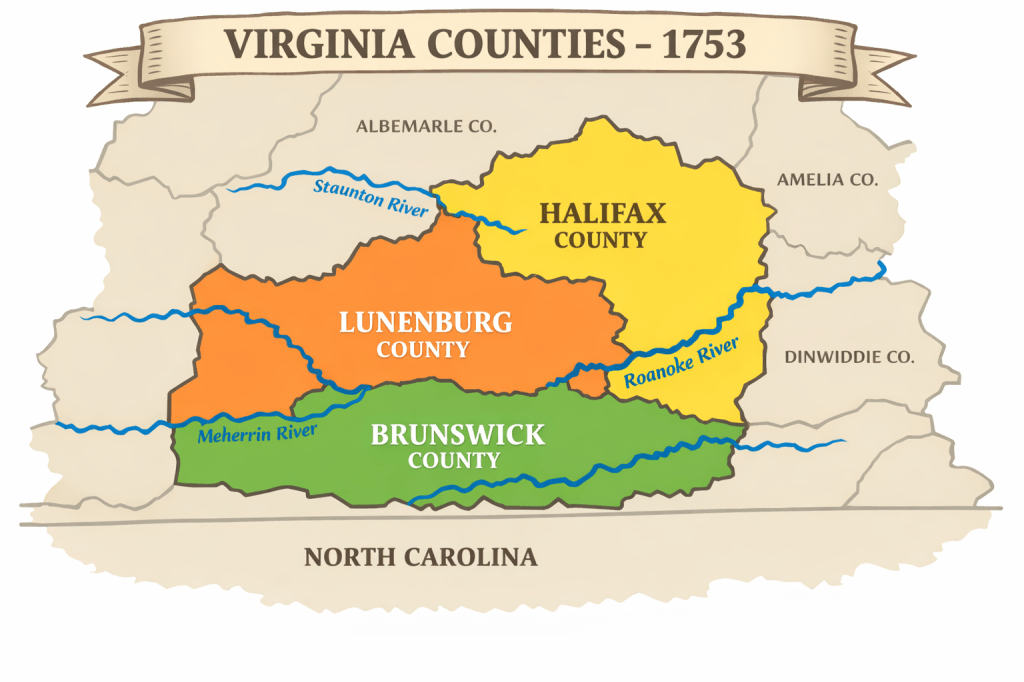
The first question to come for MortonLegacy.org involves the confusion regarding Joseph Morton of Halifax County versus Joseph Morton of Brunswick County. The easiest way to answer this confusion is to recognize the division and dates of county origin and creation.
The shifting county boundaries of colonial Virginia explain why Joseph Morton of Brunswick appears in both Brunswick and Halifax records during a transition of county borders. Brunswick County was the parent county for the region until 1746, when its western portion was cut off to form Lunenburg County. Less than two years later, the decision was made for the northern half of Lunenburg to again be divided to create Halifax County. The exact date of this new transition is not known, but by the end of 1752 a new boundary was announced, taking effect between late 1752 and early 1753. Halifax County would border both Lunenburg County, and extend down toward the border of Brunswick County. Families living along this rural and confusing line—such as John Binum, whose land straddled the changing jurisdiction—suddenly found themselves under a different county’s authority. As a result, Joseph Morton of Brunswick (my line) filed his 1753 debt‑recovery action in both Brunswick and Halifax, not because he moved, but because the county line moved over the location of the dispute and John Binum was in that area. At the same time, the other Joseph Morton in the region—the one belonging to the unrelated Halifax/Orange‑VA Morton family—had already written his will in 1749 and was dead before March 1753, when his estate was probated in Halifax. In contrast, Joseph Morton Sr., son of John the Immigrant, lived several years longer, with his estate not divided until 1758 in Brunswick County, confirming that the two men were entirely separate individuals caught in different jurisdictions and different family lines.
The counties of Brunswick, Lunenburg, and Halifax were created in rapid succession, and their shifting borders directly affected where records were filed. This is why Joseph Morton Sr. of Brunswick (my line) appears in both Brunswick and Halifax records in 1753 when he pursued a debt recovery involving Binum. For DECADES Morton researchers “combined” both Joseph Morton men without recognizing a difference. This error was repeated.
Genetic historians were finally able to apply science to separate all the Morton lines in Virginia and group them into three distinct Morton groups: the Henrico Morton group of John the Immigrant, the separate Richmond to Orange County “Northern neck” group, and the separate “Coastal” Northumberland Northern neck group. Modern DNA tools made it possible to see what the paper trail alone could never fully reveal. We can be grateful to those who initiated this undertaking!
All groups of Mortons share deep paternal roots in Yorkshire, England, long before anyone named Morton ever set foot in Virginia. That ancient connection is why descendants of all lines sometimes match at low levels on autosomal tests. But the breakthrough came when researchers began isolating maternal‑line DNA clusters—the female surnames that travel through families generation after generation. Once those clusters were mapped, the completely different communities emerged. Concerning the Halifax/Lunenburg → Pittsylvania → Orange County, VA Morton group: they carried the maternal signatures of the elite planter families of northern and central Virginia—Earle, Roy, Bourn, Snead, Mothershead, and Street. In contrast, the Brunswick → Lunenburg → Granville/Orange NC Morton line carried the Saponi/Occoneechi‑adjacent and frontier maternal clusters—Harris, Self, Martin, Wren, Russell, Jeffries, Nance—along with their long‑standing frontier neighbors Thompson, Allen, Brooks, Reynolds, Murphree, and Bynum. The maternal‑line DNA clusters associated with the three Virginia Morton families (the Brunswick/Lunenburg frontier line, the Halifax/Orange‑VA Northern Neck line, and the older Northumberland coastal line) never overlap. Each group carries its own distinct set of surnames, kin‑networks, and autosomal cluster signatures. The maternal DNA patterns, combined with Y‑DNA and autosomal clustering, proved that the Joseph Morton who died in Halifax before March 1753 belonged to the elite Halifax/Orange‑VA line, while the Joseph Morton of Brunswick—whose estate was not divided until 1758—belonged to the entirely separate frontier line that migrated into North Carolina and later Alabama. This genetic separation, grounded in both paternal and maternal evidence, finally resolved a confusion that had persisted for more than a century.
I will add one fact for future researchers: the county of Mecklenburg, Virginia lay directly along the migration corridor leading from Brunswick and Lunenburg into Granville and Orange Counties, North Carolina. At present, every Morton record found in Mecklenburg belongs to the Halifax → Pittsylvania → Orange‑VA Morton group, not to the Henrico → Brunswick → Lunenburg → NC Morton line. It is always possible that a future “full‑text” transcription may reveal an overlooked reference to one of the Henrico Mortons, but the current evidence shows that they did not linger in Mecklenburg. Instead, they moved straight through the region into Granville County, with haste made possible through the same Saponi and Occoneechi guides who were working with Joseph Morton Jr. and his frontier kin‑network, like the Longhunter Daniel Murphree, who served as Captain when Joseph Morton Jr served in the Virginia militia.
Daniel Murphree was born about 1720–1730 and dead before 1780. He lived and worked in the same frontier corridor as Joseph Morton Jr. Daniel hunted the backcountry from the Catawba to the Broad River, interacted with the same kin‑network as the Mortons (Thompson, Wren, Russell, Bynum, Harris, Self), and fathered Solomon Murphree (1757–1854), whose descendants later migrated into South Carolina and Alabama.
Sources for further use…
County Formation and Boundary Changes:
- Iberian Publishing Company. Lunenburg County, Virginia – County History. Notes that Lunenburg County was formed from Brunswick County in 1746 and that Halifax County was created from Lunenburg in 1752–1753.
- FamilySearch Research Wiki. “Virginia County Creation Dates and Parent Counties.” Confirms formation dates and parent counties for Brunswick (1720), Lunenburg (1746), Halifax (1752–1753), and Mecklenburg (1764–1765).
- Lunenburg County, Virginia – Official County History. States that Mecklenburg County was created from the southern portion of Lunenburg in 1764/1765.
- Halifax County, Virginia Will Book 0. Will of Joseph Morton, written 1749; estate proved before March 1753.
- WikiTree Profile: Joseph Morton (1693–1753). Summarizes probate date and Halifax County residence.
- Brunswick County, Virginia Court Order Books (1750–1758). Records debt‑recovery actions filed by Joseph Morton Sr. and the division of his estate in 1758.
- Lunenburg County, Virginia Court Records. Show overlapping jurisdiction during the 1746–1753 boundary transitions.
- DNA and Morton Line Separation:
- Morton Y‑DNA Surname Project. Demonstrates distinct Y‑DNA haplogroups for the Henrico, Halifax/Orange‑VA, and Northumberland lines.
- Autosomal Cluster Analysis (private project). Identifies non‑overlapping maternal‑line surname clusters for each Morton group.
- Maternal‑Line Surname Mapping (private project). Shows the elite Northern Neck cluster (Earle, Roy, Bourn, Snead, Mothershead, Street) versus the Saponi/Occoneechi‑adjacent frontier cluster (Harris, Self, Martin, Wren, Russell, Jeffries, Nance, Thompson, Allen, Brooks, Reynolds, Murphree, Bynum).
Frontier Network and Longhunter Daniel Murphree: - Revolutionary War Pension File: Solomon Murphree (W8442). Establishes Solomon’s birth in 1757 and his father as Daniel Murphree, placing the elder Daniel in the 1720–1730 birth range.
- North Carolina Colonial Militia Records. Document the presence of Daniel Murphree in frontier militia activity during the mid‑18th century.
- South Carolina Backcountry Hunting and Trading Accounts (Catawba–Broad
 MORTON Roots & Branches